Food Insecurity
Discovery Research
Selected Research Artifacts
The research moved from secondary evidence into fieldwork. These report-slide exports show the desk research frame that grounded the later screener, interviews, affinity mapping, and questionnaire design.
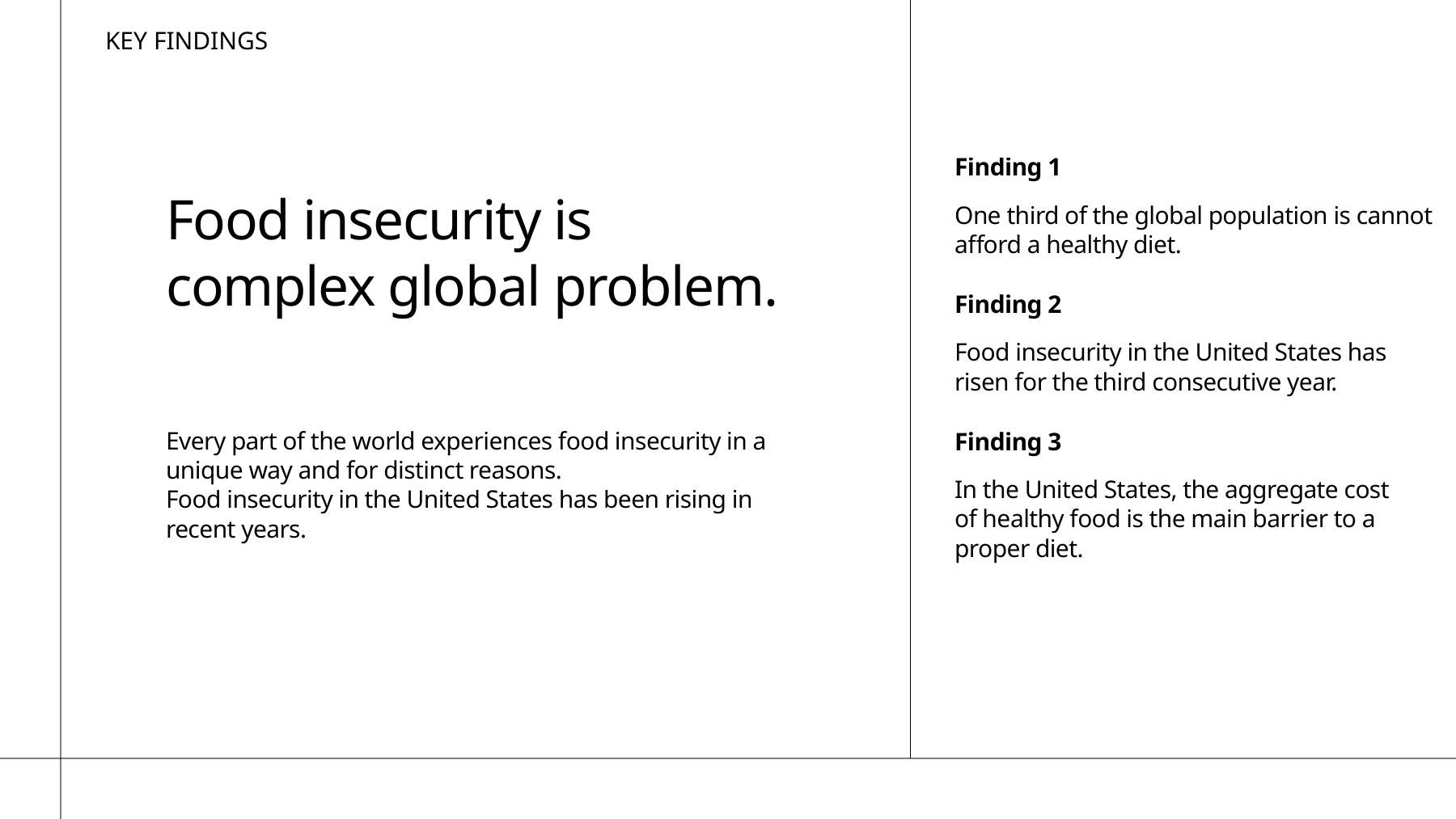
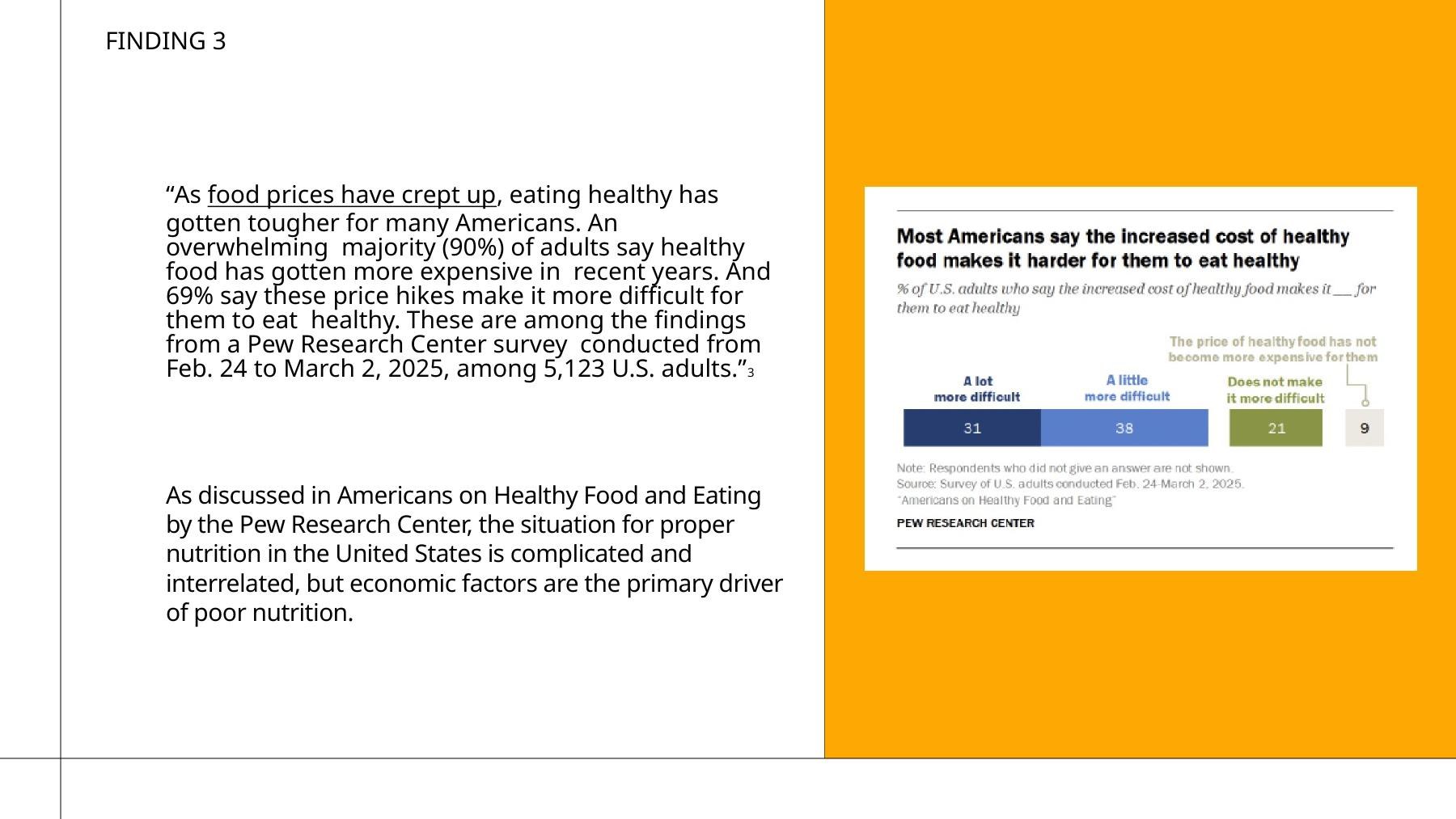
The report cites World Bank and FAO data showing that roughly one third of the global population could not afford a healthy diet.
Food insecurity rose after pandemic-era supports expired and food prices stayed high.
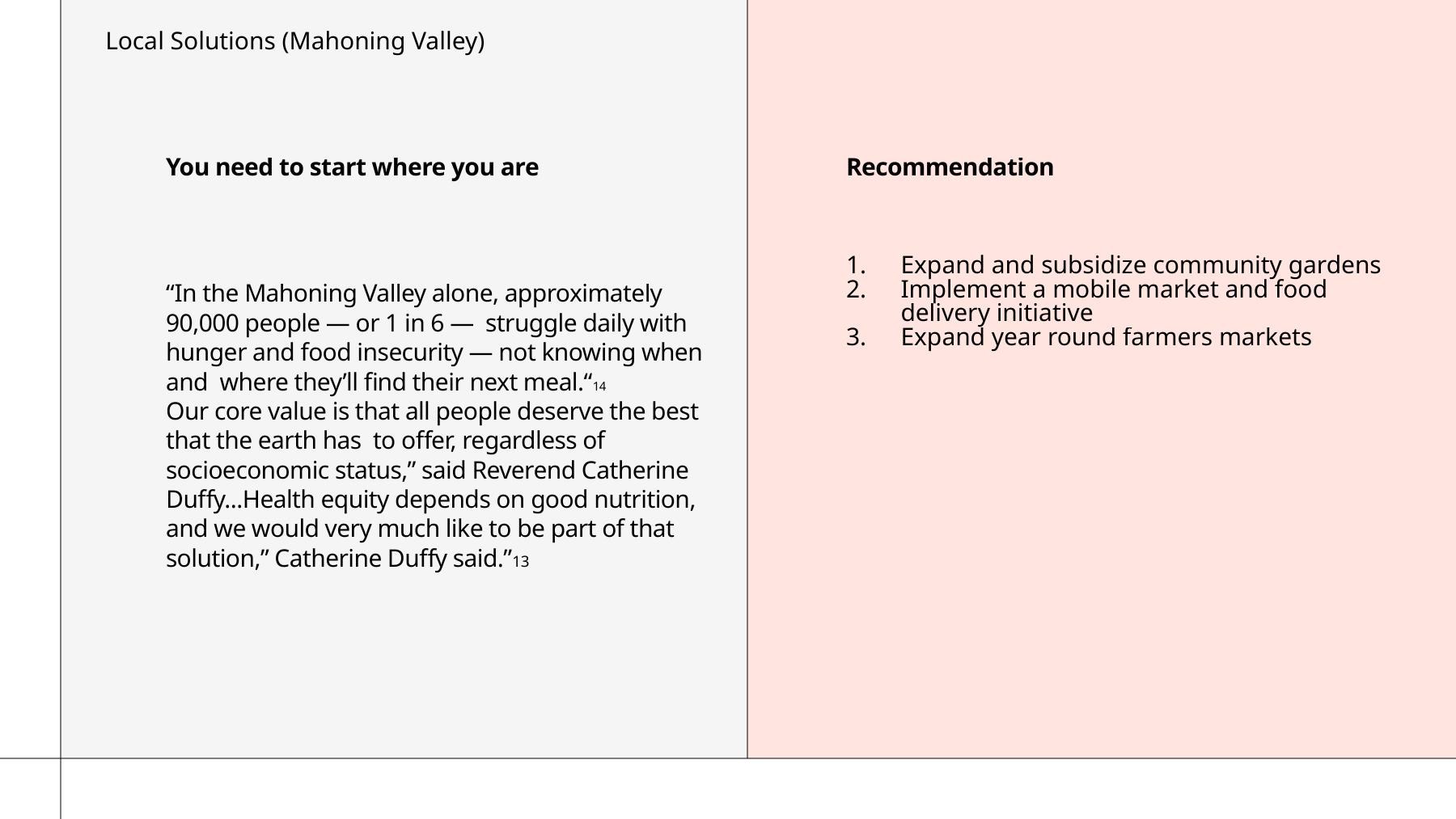
The Mahoning Valley section grounds the national pattern in a regional estimate: about 90,000 people struggling with hunger and food insecurity.
The Problem
The Mahoning Valley, the post-industrial corridor straddling northeast Ohio and western Pennsylvania, anchored by Youngstown, is a region still working through the long aftermath of deindustrialization. The economic disruption that began in the late 1970s reshaped the Valley in ways that are still visible today: in vacancy rates, in health outcomes, in food access. Roughly one in six residents, approximately 90,000 people, struggles with food insecurity.
That number is a policy statistic. It tells you very little about what food insecurity actually feels like to navigate: the decisions people make, the systems they rely on, the workarounds they have developed, the dignity costs embedded in the experience. Discovery research exists precisely for situations like this, when you need to understand a problem before you can responsibly design anything to address it.
The Research Question
The guiding question for this project was framed deliberately broadly:
“How can we develop novel, sustainable solutions to improve food security and quality of life for the 90,000 residents (1 in 6 people) in the Mahoning Valley who struggle with food insecurity?”
A discovery question is not a problem statement. It is an orientation, a way of bounding the inquiry without foreclosing the answers. Keeping it open at this stage was intentional. The goal was to learn what the problem actually is before deciding what to build.
Research Design
Before any interviews could happen, I needed to solve a recruitment problem. The screener had to identify people with direct, lived experience of food insecurity in the Mahoning Valley without framing the subject in a way that triggered disengagement or self-censoring. Food insecurity carries real stigma. The instrument had to be precise enough to recruit the right participants and careful enough not to lose them before the interview began.
Inclusion Criteria
Three gates determined eligibility. First, age: participants had to be 18 or older, keeping the study clear of the ethical and methodological complexity of conducting research with minors. Second, geography: participants had to live within Mahoning Valley zip codes, since this was a regional study and location shaped food access. Third, active food acquisition: participants needed to be people who actually shopped for or otherwise obtained food, not someone entirely removed from that process. The screener verified all three through simple, non-leading questions.
Exclusion Criteria
Professional background mattered. People working in food retail, public health, social services, market research, or food assistance programs were excluded to avoid conflating professional knowledge with lived experience. Participants who had been in a food or nutrition study within the past year were also excluded to guard against research fatigue. Internet access was a practical requirement, since later phases of the study (the questionnaire, potential prototype testing) would happen online.
Language and Framing
The screener introduced the study as research into “food shopping habits in the Mahoning Valley” rather than “food insecurity.” That framing was intentional. Describing the topic neutrally reduced the chance that participants would feel pre-labeled or defensive before any conversation took place. The closing question asked participants to briefly describe their last grocery shopping experience, a concrete, low-stakes prompt that gave an early signal about how someone talks about food access without requiring them to self-identify as food-insecure.
Two-Population Consideration
I considered recruiting two subpopulations: individuals experiencing food insecurity directly, and social workers or case managers who encounter it professionally. The logic was that frontline professionals could provide a systemic view that individual participants might not have. The dual-population approach was ultimately scoped down to keep the study manageable, but the interview with a family services administrator did surface a valuable finding: people in administrative roles at relevant agencies did not always know what food resources were available in their own region. That gap between institutional position and actual knowledge became a data point in its own right.
Methods
This was a full mixed-methods research cycle. The qualitative and quantitative work were not parallel tracks. The qualitative phase informed the survey instrument, which then tested whether patterns from the interviews held at broader scale.
Discovery Interview Protocol
The discussion guide was structured around semi-structured, open-ended prompts designed to surface behavior, not opinion. Asking someone what they think about food insecurity gives you responses shaped by what they believe they should say. Asking them to walk you through a specific week, a specific decision, a specific moment at a food bank or grocery store: that is where the usable data lives.
The guide moved through five areas: daily food acquisition routines, decision-making under constraint, use of and friction with existing support systems (SNAP, food banks, community pantries), social and emotional dimensions of food insecurity, and aspirations, what a meaningfully different situation would look like from where they stood. Real participants were interviewed. These were not hypothetical scenarios.
One early interview revealed something instructive about discovery work. The participant, an administrator at a family services agency (not the Ohio Department of Job and Family Services, but a family-based organization), disclosed that her agency provided food vouchers to clients in acute need. But she had limited knowledge of the broader food assistance network in the region. This gap between institutional access and resource awareness reinforced a pattern that would surface again in the quantitative phase: people who should know what resources exist often do not.
Affinity Diagram
Synthesis happened through a large-scale affinity diagram built from interview transcripts. The process involved pulling discrete observations and quotes onto individual nodes, then clustering bottom-up, grouping by emergent similarity rather than imposing categories in advance. The final artifact ran to 90MB as a PDF, which gives some sense of the scope: this was not a light pass over the data. It was the kind of granular synthesis where the goal is to let patterns emerge rather than confirm what you already suspected.
Affinity diagramming at this scale forces you to sit with contradictions. Some participants had adapted to chronic food insecurity in ways that were remarkably resourceful; others were in acute crisis. The diagram had to hold both without flattening the difference.
Questionnaire Design
The survey instrument was developed after the qualitative phase, not before it. Constructs pulled from interview synthesis were operationalized into survey items, a sequencing choice that matters. Starting with a questionnaire locks you into assumptions about what is worth measuring. Building it from interview data means you are measuring things that participants themselves identified as significant.
The questionnaire used five questions, each chosen for a specific analytical purpose. A frequency measure asked how many meals were skipped or reduced in the past seven days, producing a concrete behavioral baseline rather than a self-assessment of how food-insecure someone felt. A resource usage question (select all that apply) covered food banks, SNAP, WIC, free meal programs, church organizations, food vouchers, mobile food markets, and community gardens. This generated data on which services were actually used and how many services an individual relied on simultaneously.
A transportation question anchored to the participant's most recent grocery or food resource trip captured real behavior rather than generalized habits. The interview data had surfaced transportation as a significant barrier, and this question provided quantitative data on whether that pattern held at scale. A Likert-scale ranking question forced prioritization across five barriers: money, transportation cost, distance to resources, time constraints, and awareness of available programs. Forcing a rank order rather than allowing independent ratings revealed relative importance, not just presence.
The final question was open-ended, a deliberate catch-all for information the structured items might miss. This served a secondary function: testing whether the structured questions were even asking about the right things. If the open-ended responses consistently surfaced themes the closed questions had not captured, that would be a signal to revise the instrument.
Persona Development
The synthesis work also included persona creation, with a specific focus on bias-aware construction techniques: using sketches instead of photographs to avoid triggering gender and racial assumptions, omitting demographic fields (like sex) when they were not relevant to the design context, and structuring “Needs and Goals” to capture pain points and desired outcomes without reducing them to a flat requirements list. These were principles I carried back into the food insecurity work when thinking about how to represent participants without flattening their experience.
What I Found
Access is not the only problem
Geographic access to food (proximity to grocery stores, transportation) was a real barrier for some participants. But it was rarely the only barrier and often not the primary one. The more consistent theme was the cognitive and emotional load of managing food insecurity over time: the constant calculation, the planning around unreliable income cycles, the social navigation of using programs that carry stigma. Distance to a food bank is a design problem with tractable solutions. Sustained psychological toll is a different category of problem.
Existing systems create their own friction
SNAP, food pantries, and community support programs appeared consistently in participant accounts, but not as frictionless solutions. Participants described scheduling complexity, eligibility bureaucracy, inconsistent availability of preferred or culturally relevant foods, and the visibility cost of using programs in small communities where anonymity is hard to maintain. A support system that works mechanically but creates friction at every human touchpoint is not fully working.
Resourcefulness is not the same as resilience
Several participants had developed elaborate, effective workarounds: strategies that demonstrated real ingenuity about how to stretch food budgets, coordinate with neighbors, or time purchases around sales cycles. It would be easy to read this as evidence of resilience. It is also evidence of how much cognitive capacity chronic scarcity consumes. The workarounds are impressive. The fact that they're necessary is the finding.
Poverty is the root, but policy creates compounding failures
Interview participants and the questionnaire data both pointed to poverty as the primary driver of food insecurity, which is not a surprise. What was more revealing were the specific mechanisms by which policy and institutional structure compounded that baseline problem. One interview surfaced a concrete example: when a caretaker takes custody of a minor who is not from the same immediate family, they cannot get food stamps for that child. The policy logic makes sense from an eligibility standpoint. The human outcome is that a child in a new home goes without adequate food assistance during a period of acute vulnerability.
Resource awareness is lower than expected, even among professionals
The questionnaire included “don't know what resources are available” as a rankable barrier, and participants rated it more highly than anticipated. This aligned with the qualitative data: even the family services administrator interviewed in the qualitative phase had limited awareness of available food resources in the region. If people working in adjacent professional roles do not know what is available, it is unreasonable to expect residents navigating food insecurity on their own to have better information.
The JTBD Question
Alongside the primary research, I conducted a critical analysis of a published JTBD study. The paper (Domenici et al., 2025) claimed to apply Jobs-to-Be-Done to consumer meat product innovation, using a three-phase study with interviews, semiotic analysis, and concept validation. Working through that paper raised questions I kept turning back toward my own data.
The central problem with the Domenici study was that it called its findings “jobs” when they were actually requirements. Statements like “it should be easy and quick to prepare” or “it should elicit positive emotions” do not follow the JTBD format: “When I am in [context], I want to [job] so I can [outcome] because [motivation].” The researchers also skipped observation entirely, going straight to interviews, and never classified their findings into functional, emotional, or social job layers. The result was an elaborate study that uncovered consumer preferences and called them innovations. The concepts they validated (meal boxes, recipe recommendations) already existed in the market.
That critique sharpened how I thought about applying JTBD to my own food insecurity data. JTBD is a framework built around the idea that people “hire” products and services to accomplish specific functional goals. The vocabulary maps well onto consumer product contexts. The canonical example of someone hiring a milkshake for a morning commute is instructive precisely because it is so banal.
Food insecurity is not banal. The “job” framing risks reducing a complex, constrained, dignity-laden experience to a functional transaction. If you applied JTBD to someone navigating chronic food scarcity, you would risk producing a clean-looking analysis that misses everything socially and emotionally significant about what that person is actually going through.
That said: the functional job layer (what people are concretely trying to accomplish when they engage with food assistance systems) does yield real signal. What participants wanted was reliable access, reduced planning burden, and options that did not require them to sacrifice quality or dignity. Those are designable. The critique is not that JTBD produces no insight in this domain. It is that taken alone, without the emotional and social job dimensions, it produces incomplete and potentially misleading insight.
The more honest version of a JTBD analysis in a context like this requires foregrounding the emotional and social job layers, not treating them as secondary to the functional. For a population managing chronic constraint, the functional job is often straightforward. The emotional job (maintain dignity, avoid judgment, preserve a sense of agency) is where the real design challenge lives. The Domenici study demonstrated what happens when you skip that work: you end up with requirements dressed as insights.
What a Longer Engagement Would Add
Any research project has a scope boundary. A longer-running discovery engagement in this domain would extend in several directions:
- Participatory design from the outset. Community members with lived experience of food insecurity should be involved in shaping the research questions, not only answering them. That changes both what gets studied and how findings get interpreted
- Stakeholder mapping across the food system . Interviewing food bank staff, SNAP case workers, community organizers, and local farmers alongside residents would surface the systemic constraints that participants experience downstream
- Longitudinal observation. Food insecurity is not a static state. A single interview captures a moment. Understanding how people's situations and strategies shift across a month, a season, a benefit cycle requires return visits or diary studies
- Design recommendations with implementation path . Discovery findings need somewhere to go. A professional deliverable would include prioritized opportunity areas, initial concepts, and a clear line from research insight to design direction
- Community validation . Before any recommendations go forward, the synthesis should be reviewed with the community it came from. The people who gave you the data should have a chance to say whether your interpretation of it is right
Skills Demonstrated
Research Artifacts
- Final research report (PDF)
- Participant screener
- Questionnaire design and rationale
- Affinity diagram synthesis artifact (not currently published on this site)
- JTBD case study analysis