Oblique Oracle: Algorithmic Divination as Design Research
The iPhone app is in beta testing through TestFlight. Try the web demo or read the privacy policy.
The Idea
Most AI interactions are transactional: you ask a question, you get an answer. Oblique Oracle inverts that relationship. Instead of optimizing for the “right” answer, it deliberately introduces indeterminacy: ancient divination systems and lateral thinking prompts, then asks AI to find meaning in the collision.
Accuracy is the wrong measure for the interaction. The test is whether a structured, visibly ambiguous prompt changes how a person frames a problem and judges the resulting synthesis.
The research frame comes from three established lines of work: ambiguity as a design resource, generative constraints in creative work, and divination artifacts as resources for negotiated meaning. Oblique Oracle turns that literature into a testable interaction question rather than using it to claim that the app is novel by default.
How It Works
Three systems converge on every reading:
I Ching Hexagram Generation
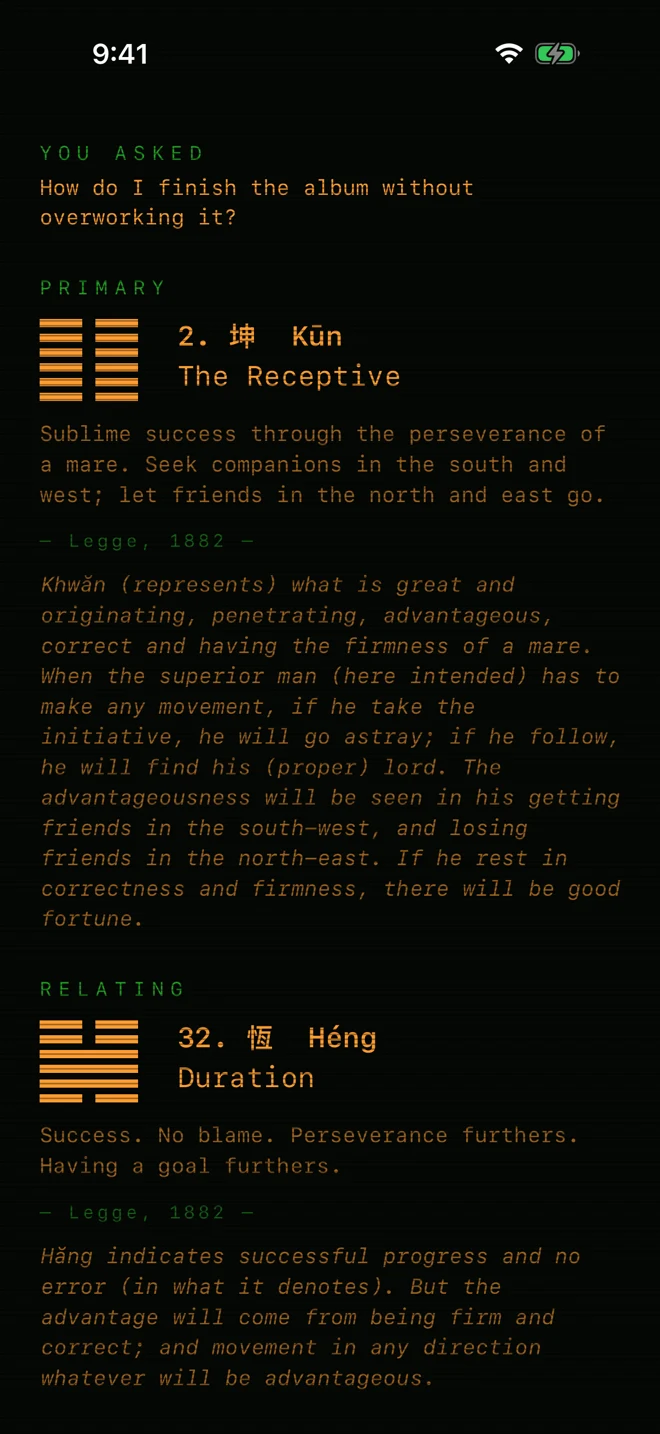
Simulates the three-coin method: three fair coin draws for each of six lines. The public demo therefore uses coin-method probabilities, not yarrow-stalk probabilities. It generates a primary hexagram and, when lines change, the relating hexagram. All 64 hexagrams use James Legge's 1882 public domain translation.
Oblique Strategies
Draws a random card from Brian Eno and Peter Schmidt's creative prompt deck: lateral thinking tools originally designed to break creative blocks in the recording studio.
AI Synthesis
The AI receives the user's question, the hexagram interpretation, and the oblique strategy, then streams a unified oracle response that weaves all three into a coherent reading.
The iPhone App
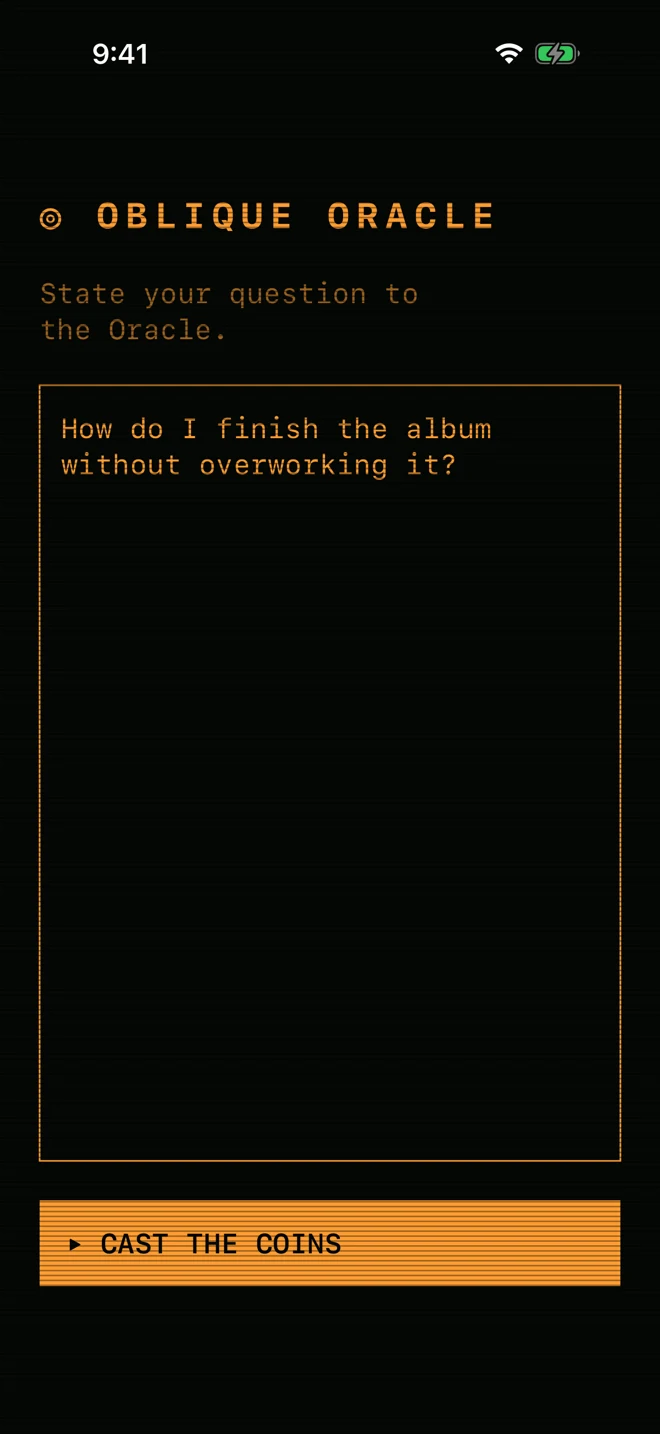
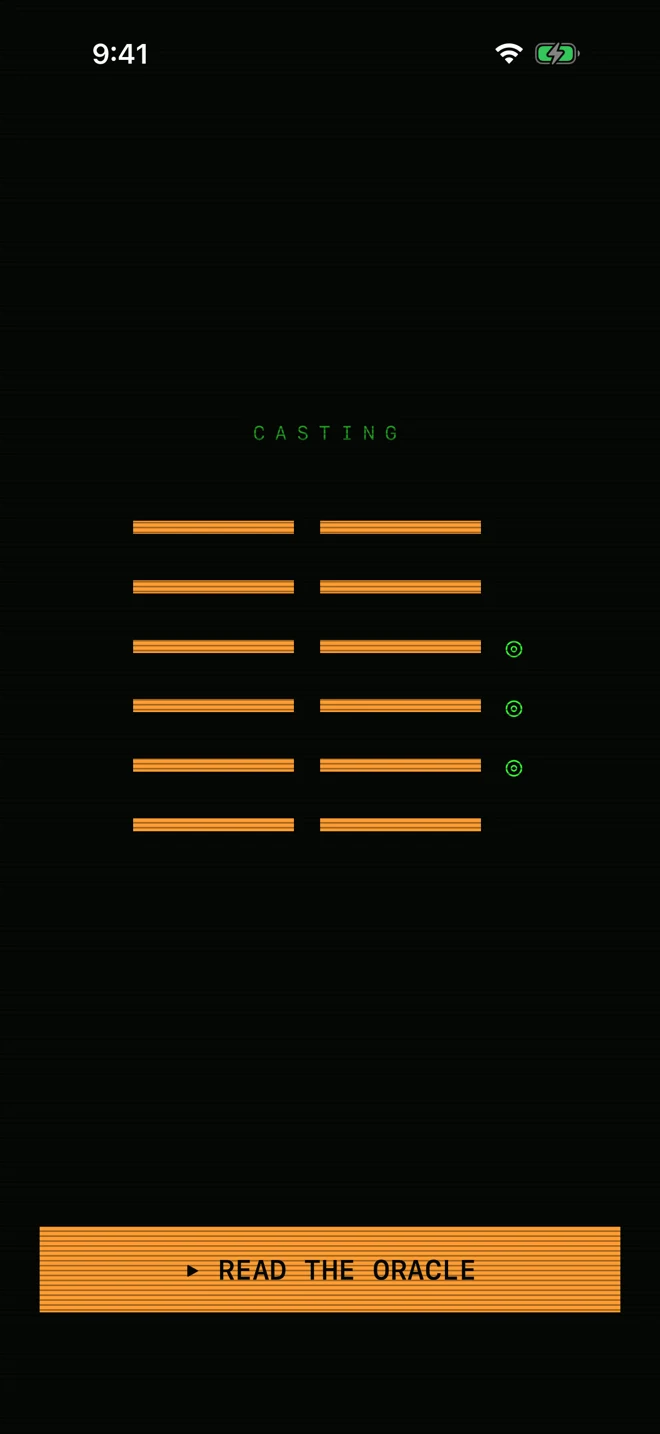
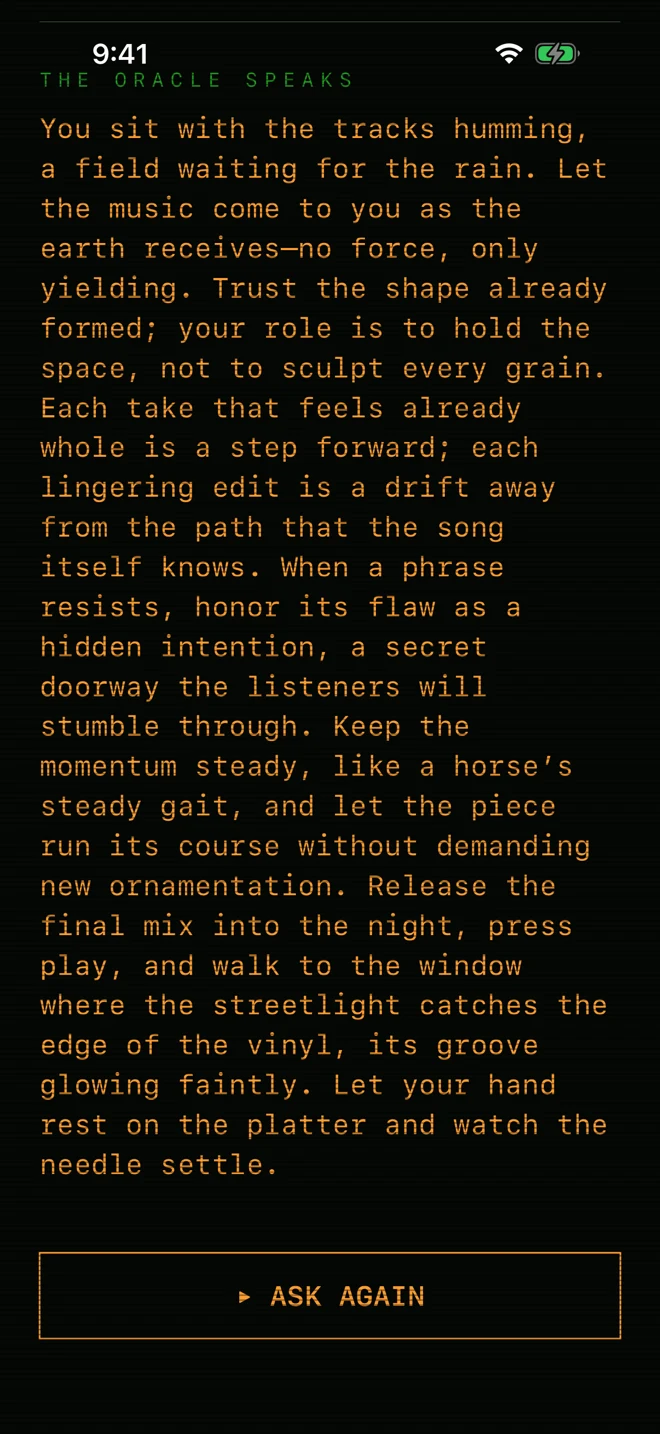
I rebuilt the prototype as a native iPhone app. You type a question, watch six coin casts build the hexagram, then read the hexagrams, the card and the Oracle's reading on one screen.
The Design Question
The I Ching has survived for millennia by creating a structured space for interpretation. Oblique Strategies reframe a creative problem through an external constraint. This prototype combines those functions with fluent synthesis and asks what the combined frame does to judgment.
AI adds a third layer. Fluent synthesis can read as authority. Oblique Oracle makes that tension visible through a deliberately non-rational frame.
Related work already includes AI-assisted tarot divination, tarot as a design method, Oblique Strategies as a creativity-support condition, and LLM-supported ideation. The open question here is narrower: what changes when an I Ching structure, a lateral prompt, and a fluent synthesis are presented as one ritualized interaction? That combination is a study condition, not a priority claim. A July 2026 search of ACM Digital Library, Google Scholar, and the cited papers below was useful but not exhaustive.
Interaction Design: The Ritual Frame
The interaction uses a ritual frame rather than a chat window. The intended mental model is consulting an oracle, and that choice shapes pacing, language, symbols, and disclosure.
The Casting Ritual
The hexagram generation simulates the three-coin method: three fair coin draws per line, repeated six times. The user watches each line form, bottom to top, with changing lines (old yin, old yang) highlighted. The pacing is meant to create a contemplative pause between asking a question and receiving an answer. That is a design hypothesis for testing, not a measured effect: the structure invites the user to sit with their question rather than rush to an answer.
CRT Terminal Aesthetic
The visual language is CRT green on void black: phosphor text, scanlines, monospace type (Share Tech Mono). The iPhone app uses the orange from this site for text and keeps green for labels and changing lines. The aesthetic is visceral in Norman's emotional design framework. It signals depth over polish, something ancient mediated through something electronic. The Eye of Providence, Elder Futhark runes, and Chinese sacred characters reinforce the ritual frame without requiring the user to understand any of the symbol systems.
Synthesis as Revelation, Not Generation
The AI response streams in character: terse, symbolic, second-person. The system prompt instructs the model to speak as “the Oracle” and weave the hexagram and oblique strategy into a single unified voice. The synthesis is capped at 200 words. No headers. No lists. The pacing and presentation matter as much as the content.
Technical Architecture
The iPhone app is built in SwiftUI, and the web demo in Next.js. The web demo implements coin-toss simulation with correct yin/yang probabilities, a lookup table from each cast to its King Wen number, changing line detection, and James Legge's 1882 public domain translation for both hexagrams. The Oblique Strategies draw currently uses a selected prompt set rather than claiming the full original deck.
A web demo runs as a Next.js static site on GitHub Pages with Cloudflare. AI synthesis routes through a Cloudflare Worker proxy, keeping API keys off the client. The architecture separates the deterministic systems (hexagram generation, strategy draw) from the non-deterministic system (AI synthesis), so the hexagrams and the card still appear when the AI is unavailable.
Readings come from gpt-oss-120b, an open-weight model from OpenAI, on Groq's free API tier. The free tier allows 1,000 requests a day for this model, enough for a prototype. The Worker sets the model's reasoning effort to low and keeps its reasoning out of the stream, so only the reading reaches the screen. The app first used Llama 3.3 70B, which Groq retired in August 2026.
Try It
◎ OBLIQUE ORACLE
The web demo runs the same casting, hexagram text and AI reading as the iPhone app. It draws from a selection of Oblique Strategies rather than the full deck.
▸ CAST THE COINSStatus
The iPhone app is in beta testing through TestFlight. Readings come from gpt-oss-120b on Groq, through a Cloudflare Worker that keeps the API key off the phone.
Links:PrivacyFigma design file
What's Next
Voice/tone calibration (balancing mystical register and practical usefulness), visual hierarchy redesign, and past reading history so users can track how their questions evolve over time.
The core research question is a comparative study: does the Oracle change how people reflect compared to a raw I Ching reading, a standalone Oblique Strategy, or a freeform ChatGPT prompt? Recent work on creativity-support tools has found that constraint-based prompts like Oblique Strategies can be perceived as more challenging but also more rewarding and engaging than open-ended LLM prompting for creative ideation, and the Oracle sits between those conditions: structured enough to provoke, synthesized enough to be accessible. The evaluation battery would include ideation metrics (fluency, novelty, variety), the Creativity Support Index (a validated psychometric), homogenization analysis (does the tool make everyone's output converge or diverge?), and think-aloud sessions to capture how users interpret ambiguous prompts.
This could become a publishable research direction after a rigorous literature review, an ethics and risk frame, and the comparative study itself. CHI alt.chi, DIS, or Creativity & Cognition may fit, but venue fit remains untested.
Research Sources
Related writing: Reflections on C&C 2024 and Working With Clarence.
- Gaver, Beaver, and Benford (2003), Ambiguity as a Resource for Design
- Le Masson, Hatchuel, and Weil (2022), Solving the Paradox of Constraints in Creativity
- Worlding with Tarot: Design, Divination, and the Technological Imagination (DIS 2024)
- Interpretive Cultures: AI-Assisted Tarot Divination (CHI 2026)
- Homogenization Effects of Large Language Models on Human Creative Ideation (C&C 2024)
- Cherry and Latulipe (2014), Creativity Support Index