Around the ring, the Camelot key wheel. Around the tube, tempo, which wraps at double time. Majors sit outside, minors inside. Tracks close together can be mixed.Drag to turn. Right-drag to move. Click the donut, then scroll to zoom. Click a track to see what it mixes with.
Music technology·Repertoire archaeology·2026
Music Atlas
Over 30 years of tunes. A way back in.
Search the public index for tracks you know, then follow the connections. Atlas Radio mixes my own library in a separate private app.
Start with one you know, or let the archive surprise you.
⌕
Loading the schema-3 public index. Search will be ready shortly.
This explorer runs in the browser against a static sanitized schema-3 export. No visitor-triggered provider APIs are called.
01 / THE IDEA
The library remembers files. I wanted it to remember relationships.
DJ software is good at storing tracks and weak at helping a person recover the connections between them. I wanted to choose one track I already knew, then ask what else in the archive could sit near it by pace, harmonic position, credit, release lineage, or scene context. The result is a retrieval tool for forgotten repertoire. Related research: the Ableton UX evaluation suite examines expert music software through several evaluation methods.
Search across artist, title, release metadata, source BPM and keys, and sectional tonal keys. Select a track, inspect its available analysis, then follow exactly ten explainable neighbors as new seeds. Every result says why it appeared. The public explorer does not expose the private audio-similarity layer, a hidden taste model, or visitor-triggered provider APIs.
02 / THE FRICTION
The software disagrees about pitch.
25.0%
Public tonal maps with one predicted key across every analyzed section.
72.7%
Public tonal maps that triggered the pipeline second-opinion rule.
These are pipeline findings, not human-labeled ground truth. The explorer keeps source lanes separate and makes disagreement visible instead of flattening it into a consensus.
03 / PUBLIC BOUNDARY
Real corpus. Deliberately narrow export.
The public instrument ships 47,445 tracks from a sanitized metadata and model-analysis export of 51,302 archive rows. That is a public export, not a claim that every archive row is public.
The export contains artist, title, album, genre, year, label, source-specific BPM and key, sectional tonal summaries, and public detail where available. No audio, paths, filenames, play history, crates, comments, private IDs, or visitor-triggered provider APIs are shipped. Sectional and arrangement labels are machine-generated provisional hypotheses, not human ground truth.
04 / THE PLAYER
I built a radio to find the tunes I forgot I owned.
After over 30 years of collecting, recall is the problem. Shuffle cannot follow a musical thread, and DJ software mostly returns what I remember to search for. Atlas Radio walks my own library by sound, choosing the next track, blending it on the beat, and recording why it made that choice. I built the iPhone and Mac apps with Claude Code in one day.
DESIGNED FOR THE DRIVE
One glance. A deliberate tap.
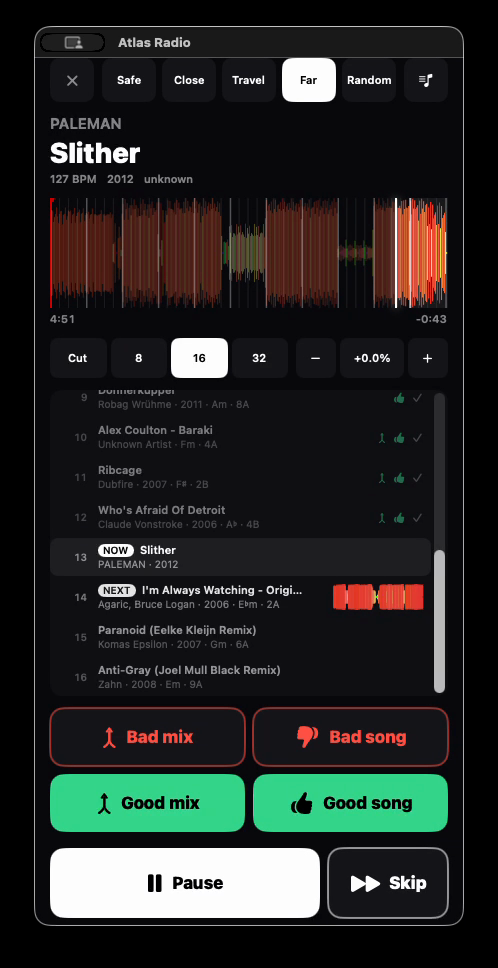
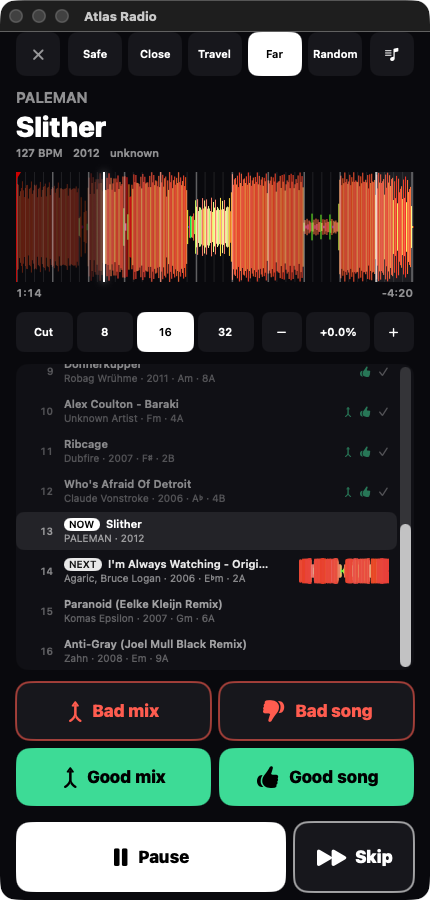
The phone sits in a car mount. A track in the run opens a menu before it changes anything. Scrubbing takes a drag; tapping the waveform does nothing. The Bad song button sits far from Play and Skip. Good mix, Bad mix, Good song and Bad song teach different lessons; a skip carries no rating.
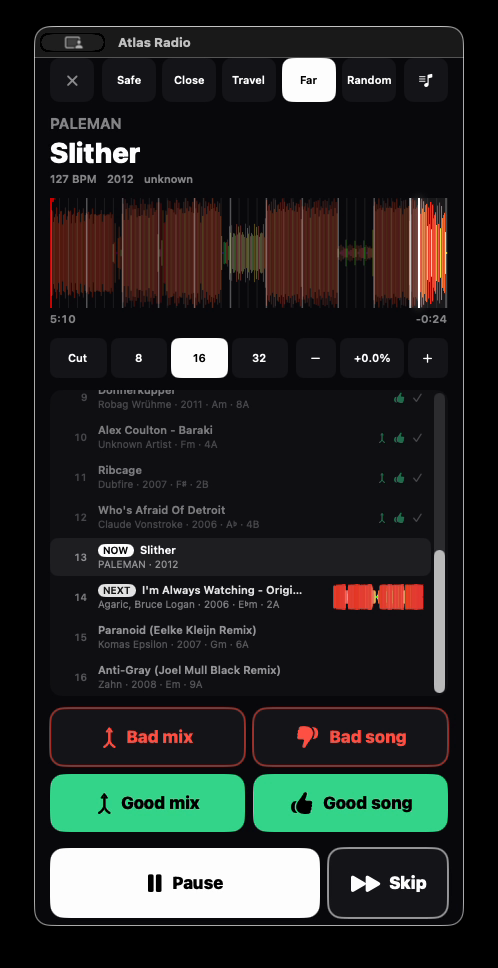
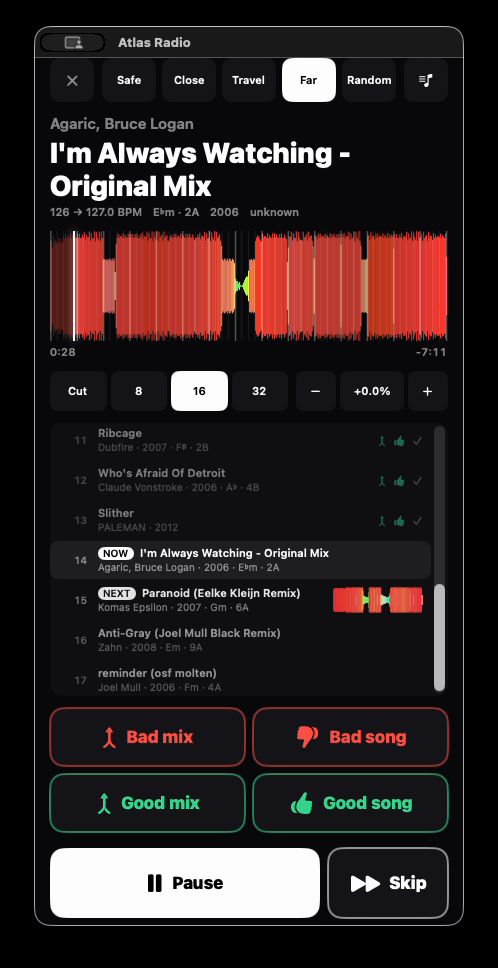
Mac app, now playing. The iPhone uses the same engine.
FROM THE PRIVATE INDEX verified 2026-09-23
Analysed tracks
50,002
Matched on phone
48,788 0 DRM
Beat grids
48,987
Waveforms
49,993
Hot cues
4,145 on 2,109 tracks
Blend phase error in tests
≤1 ms
THE WAVEFORM
Serato colors for every track.
The player draws each track the way Serato does: lows in red, mids in green, highs in blue. A kick, a vocal and a hi-hat show up as different colors, so I can read the next track before it plays. A short Python script builds them. It decodes each file with ffmpeg, cuts it into 400 slices, and measures the energy below 250 Hz, from 250 Hz to 2.5 kHz, and above 2.5 kHz. All three bands share one scale, so the color balance holds. The script skips finished tracks, so it can stop and pick up again. Reading 50,000 files off a spinning drive was the slow part, so my Mac and my Linux workstation each started from one end of the list. The app draws bar lines, phrase lines, hot cues and the shaded blend zone on top.
THE BLEND
Two decks, one downbeat.
Beat grids from Serato, with Rekordbox as fallback, line up the incoming track with the outgoing one. At the downbeat, the outgoing track takes the incoming tempo while it fades. The beats stayed within 1 ms through the blend in tests. Three silent gaps forced three different fixes: App Nap stalled a timer-driven fade, so the fade moved into the audio timeline; repeated playback-rate writes restarted audio output, so tempo changes happen once at the downbeat; and the phone needed time to buffer, so only a preloaded blend skips the wait.
01 Before02 Together03 After
The run report explains every pick: where the candidate sat among its neighbors, what it shared with the previous tracks, the key and tempo move, and how I rated the transition. I can trace a surprising choice back to the decision that made it.
RUN REPORT · 001 GHOST UNDERGROWTH
34 tracks · 33 kept · 212:15 listened · 3 pivots · 89% average similarity · 11 good mix, 0 bad
01Michael Jackson · Thriller (Betoko Rework)D♭m 12A · 120 BPM · seed played
02Justin Jay · StaticAm 8A · 118 BPM · seed played
033rd Face · Canto Della Liberta (Slow G Mix)key ? · BPM ? · seed played
04Unknown Artist · Stolen Dance remixA♭m 1A · 118 BPM · seed played
05GGP · Secret_Handshake_Brighten_MasterE♭m 2A · 122 BPM · seed played
30Stacey Pullen, Mason Collective · It's Time (Original Mix)A♭m 1A · 127 BPM · near #8 · 89% · whole tone played · good mix
31Piemont · SuperheatedGm 6A · 126 BPM · near #8 · 89% · semitone played
32Carl Craig & Moritz von Oswald · Attenuator (Moritz von Oswald Dub)Cm 5A · 127 BPM · pivot #603 · 74% · fifth played
33Alex Coulton · FunctionDm 7A · 126 BPM · near #51 · 89% · whole tone skipped 5:15
34Miguel Bastida · XAXAXA (Extended Mix)E♭m 2A · 126 BPM · near #37 · 88% · semitone played
RUN 001 The first test run: 34 tracks and 212 minutes of listening, replayed 75 times faster without sound. Angle is musical key and distance from the center is tempo. Each step shows why the radio picked the next track.
Atlas Radio stays a private local instrument. The 47,445 tracks and 51,302 archive rows above describe the public export; the player uses a separate private audio-similarity index. These selected screen captures show the interface. No raw library data, audio files, or app download are available here. The embedding model has a research-only licence, so this is not a commercial product.
04 / MODEL FIELD NOTES
Testing the first layer of a music analysis protocol.
The archive is the controlled testbed. I have now tested representation stability, tempo agreement against DJ metadata, interpretable classifier heads, and stem-based structure analysis on the same local hardware. Some methods earned a place. Others earned a narrower job.
100private archive tracks200non-overlapping excerpts20full tracks in the stem trial0completed-run failures
Music Atlas is a long-term attempt to develop a repeatable AI-assisted protocol for analyzing electronic music. The goal is to help people understand what tracks are doing and use that evidence while writing the music they want. The archive gives me a private, known corpus for testing each part of that protocol.
Retrieval is the first test harness and remains a practical part of the eventual system. A useful neighboring track gives a DJ or musician a concrete reference for groove, texture, arrangement, energy, or production choices. Some retrieval evidence is deterministic and attributable: tempo, key, and the metadata graph of artists, labels, versions, and releases. Some is learned: embedding models that place tracks near each other by how they sound. Before asking those models to support deeper analysis or composition, I needed to know whether their output remained stable on this material.
The first evidence was not good enough. This section records the correction, the stronger tests that followed, and the parts that still need human judgment.
MILESTONE / FULL-LIBRARY AUDIO RETRIEVAL
The archive can now suggest a sequence. Listening decides whether it earned the right.
The private extraction manifest covered 51,304 audio files. The final verified index contains 51,249 usable 1,280-dimensional fingerprints and 55 hard exclusions. A bounded recovery pass rescued 160 files that the first decode strategy missed. The public explorer remains a separate 47,445-track export of 51,302 catalog rows.
51,249usable private audio fingerprints55hard exclusions after recovery109.17 msaudio retrieval p9510.219×same-artist lift over chance
The full-corpus benchmark used 32 deterministic queries at ten results each. Every returned neighbor carried checked score, model, metric, and decode provenance. Audio retrieval reached 109.17 milliseconds at the 95th percentile. Same-artist retrieval was 10.219 times the chance rate within the exact eligible population. Audio and metadata rankings overlapped on only 10.625 percent of results. That difference is useful, but it does not make the audio ranking a taste judgment.
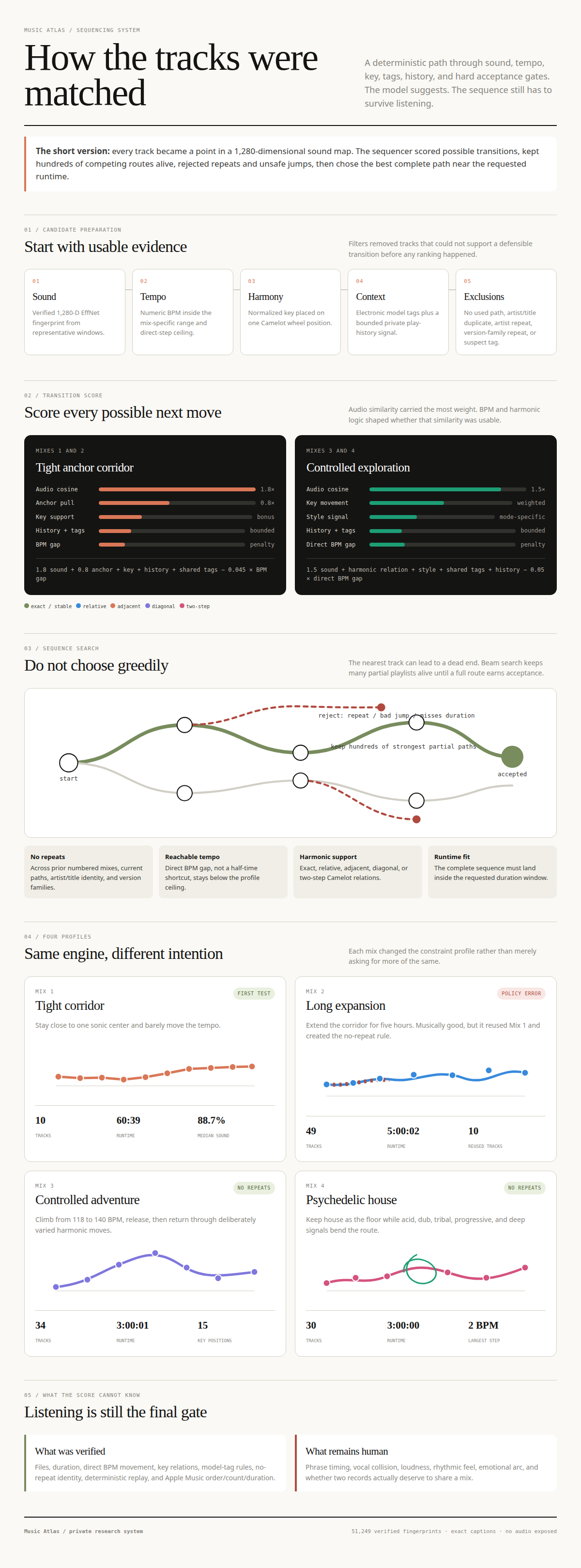
I then turned retrieval into a sequencing test. Candidate tracks needed a usable fingerprint, a private history signal, a tempo from 120 to 134 BPM, a duration from three to nine minutes, and at least one relevant techno, house, or bassline model tag. The transition score favored sonic closeness to the previous track, then closeness to the anchor, compatible key evidence, small tempo movement, shared tags, and bounded history evidence.
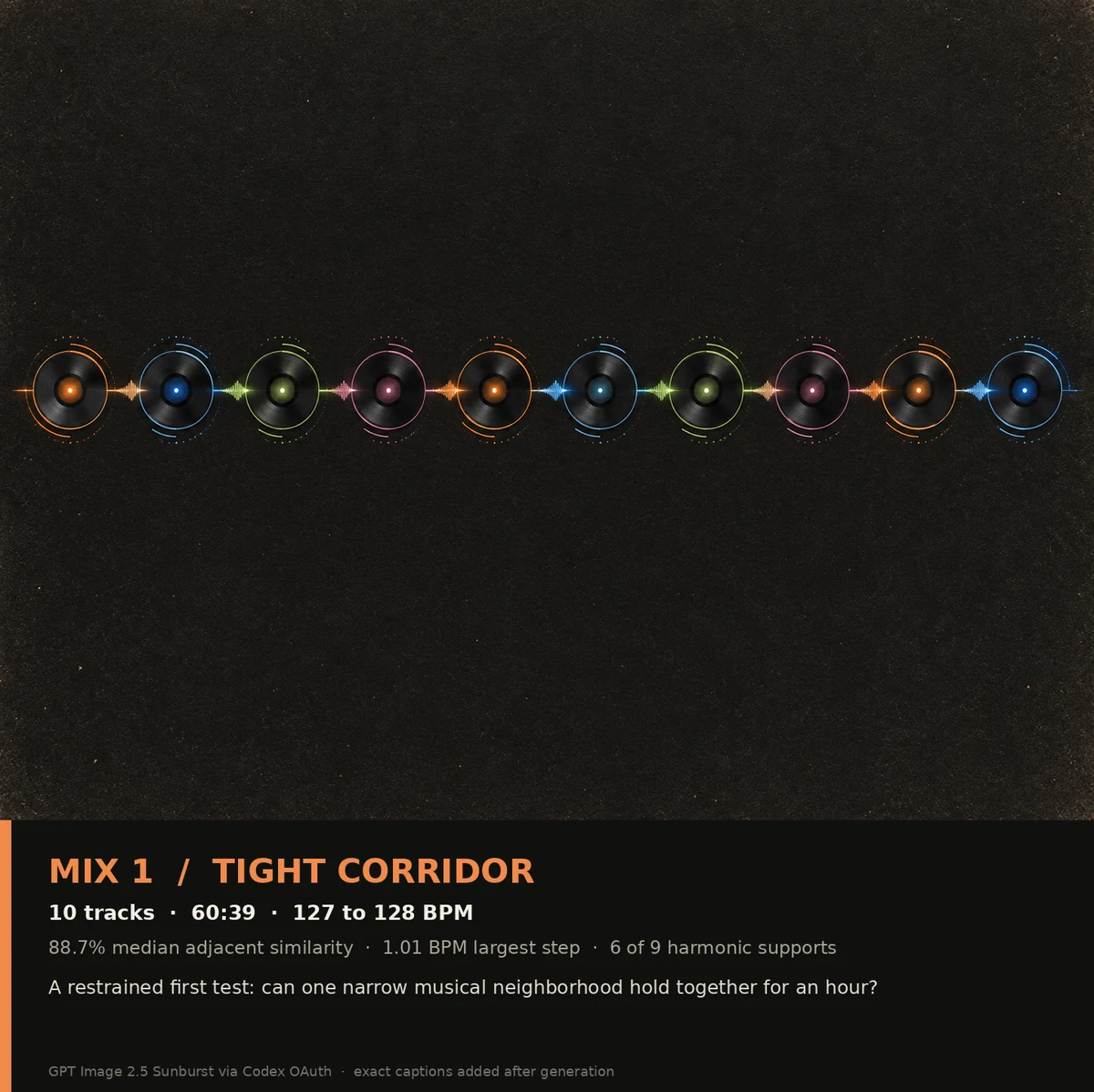
I built the sequencing code with AI assistance and kept the final choice mechanical and inspectable. A beam search compared hundreds of possible partial sequences, blocked repeated tracks and artist identities, and optimized for the requested duration. The one-hour test used ten artists and landed at 60 minutes 39 seconds. Median adjacent sonic similarity was 88.7 percent, the weakest link was 83.7 percent, and the largest tempo move was 1.01 BPM. Six of nine transitions had compatible key evidence.
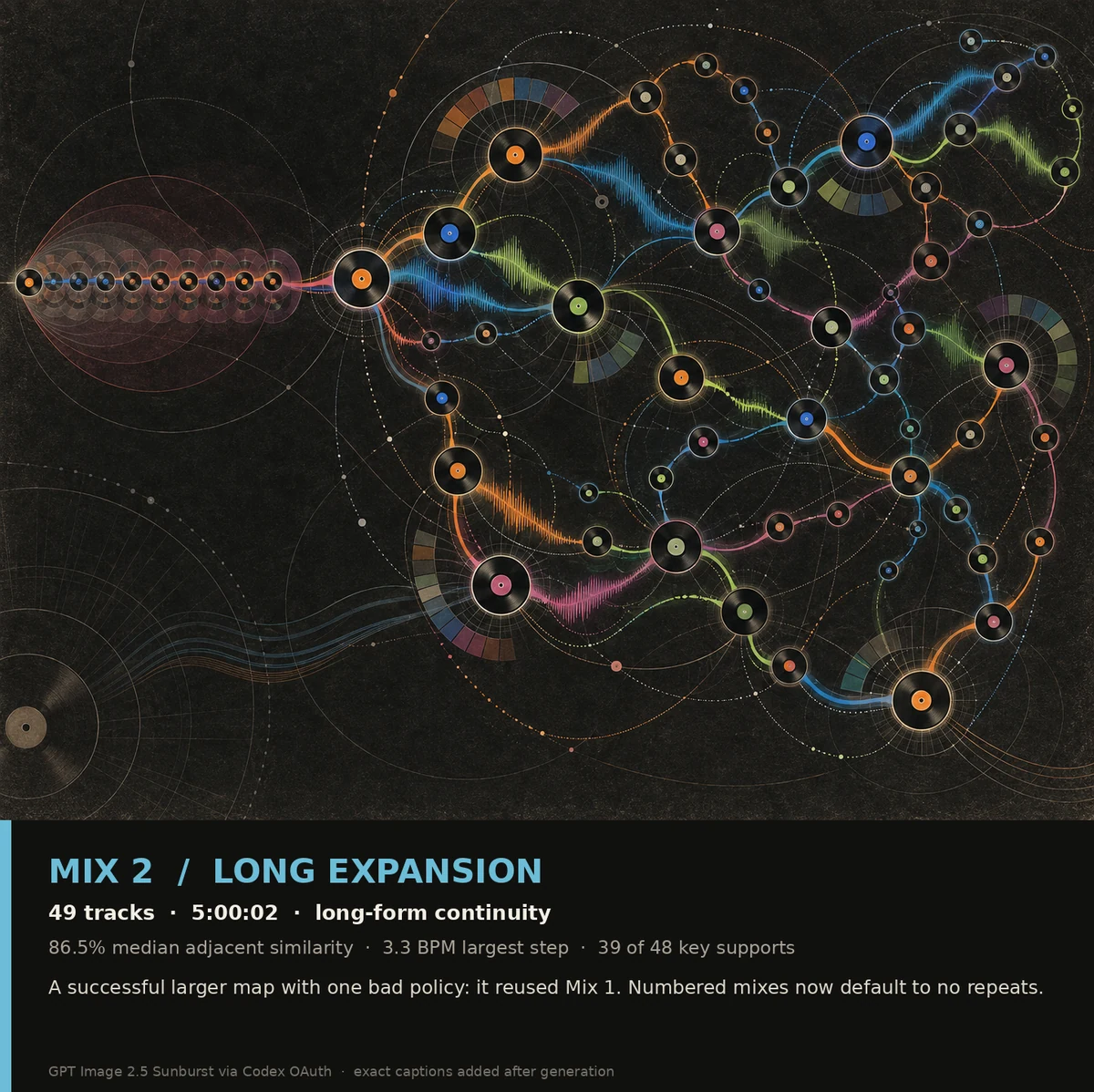
The five-hour stress test used 49 artists and landed at five hours and two seconds. Median adjacent similarity was 86.5 percent, the weakest link was 80.2 percent, and the largest tempo move was 3.3 BPM. Thirty-nine of 48 transitions had compatible key evidence. All 59 playlist entries used the standard representative-window pipeline rather than the recovery path.
The first two selections were actually good in the car. The policy was not. Mix 2 reused all ten Mix 1 tracks because I treated the longer request as an extension. That was the wrong default. Numbered mixes now exclude every earlier track unless I explicitly ask for a reprise.
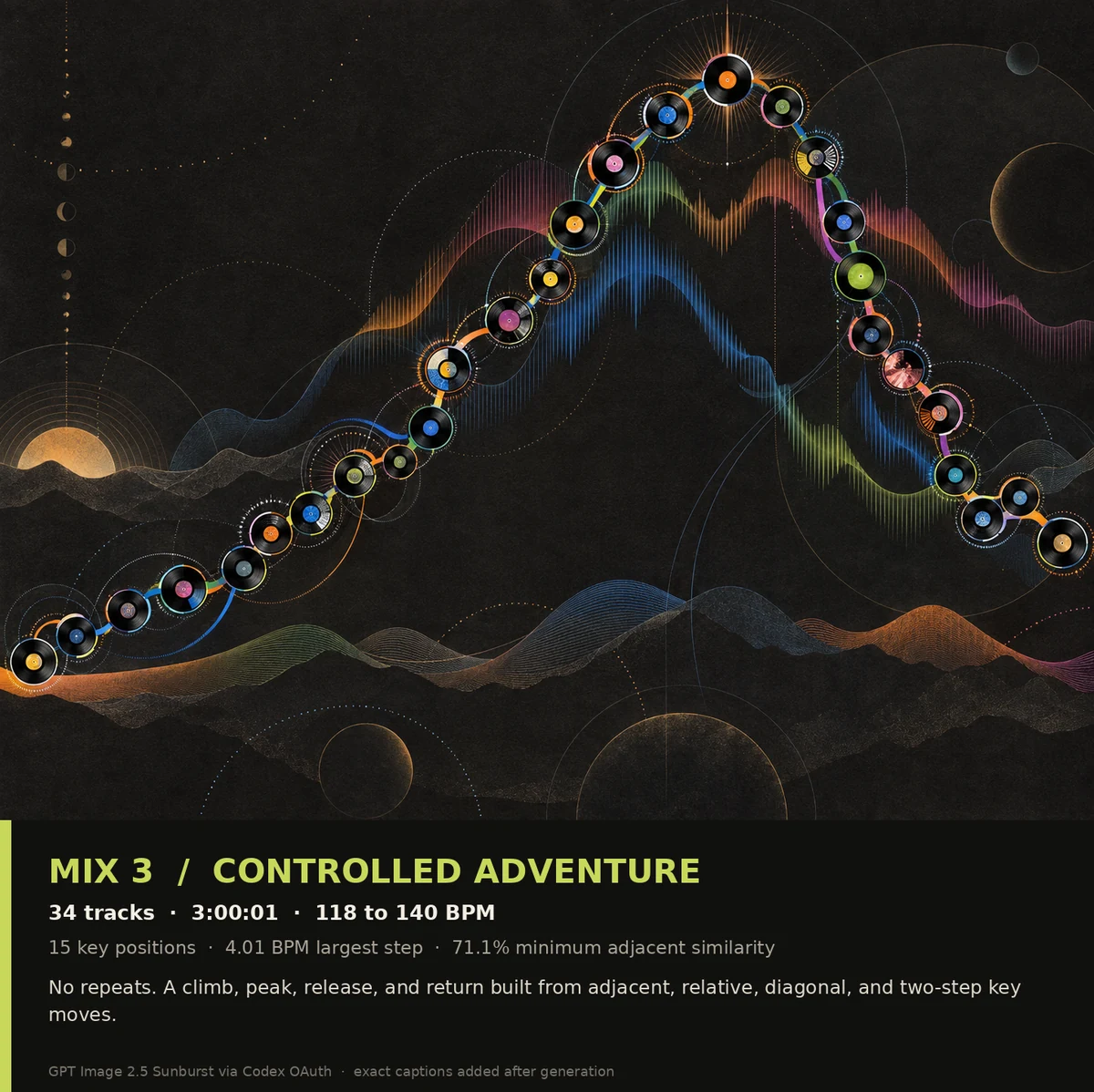
Mix 3 pushed farther out without forcing impossible changes. It used 34 tracks, landed at three hours and one second, moved from 118 to 140 BPM, and crossed 15 normalized key positions. Its 33 transitions used 16 adjacent, seven relative, seven two-step, and three diagonal Camelot moves. The largest direct tempo change was 4.01 BPM, and the weakest adjacent audio match was 71.1 percent. It shared no tracks or normalized artist-title identities with the first two mixes.
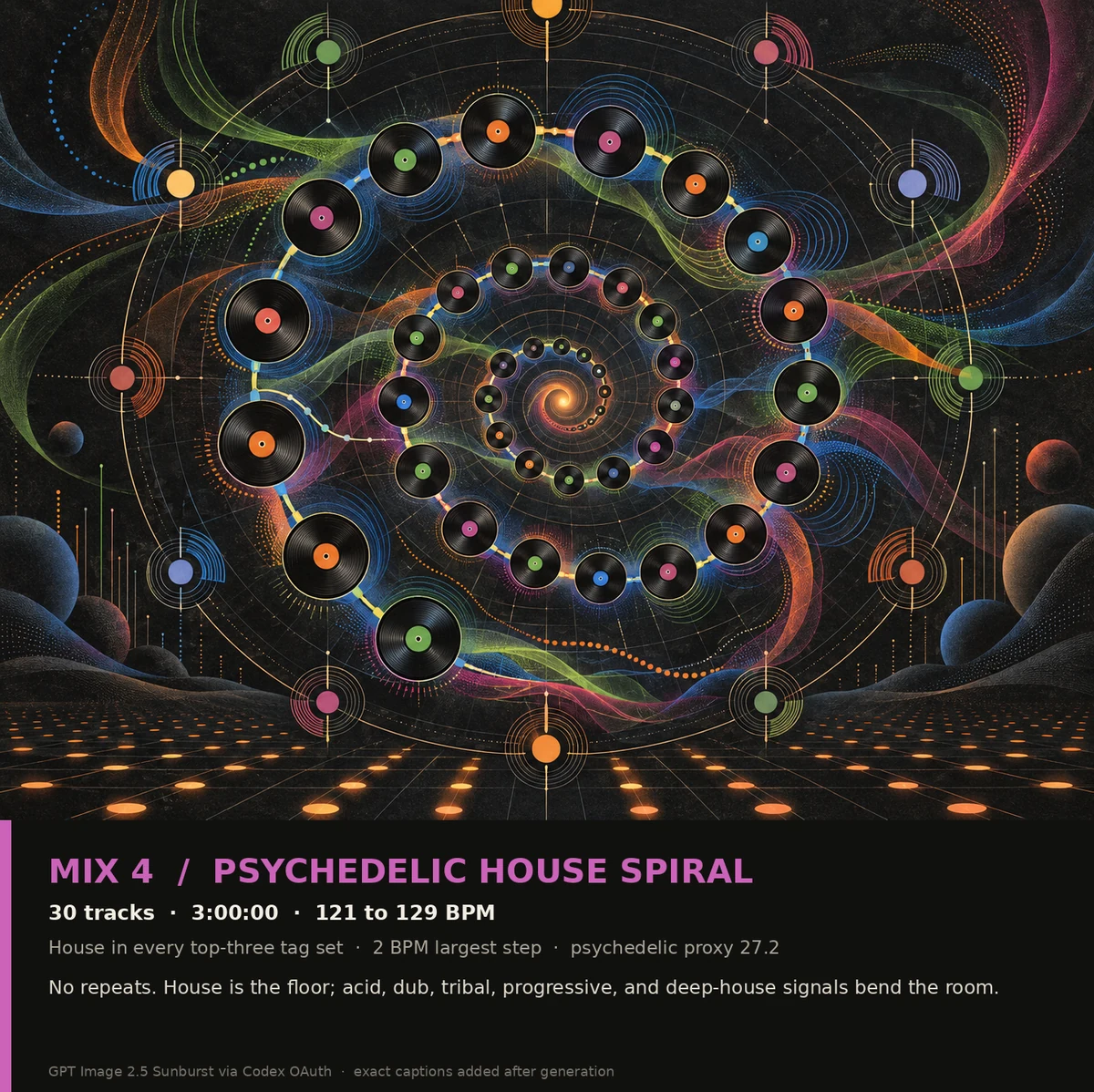
Mix 4 held house as the floor and pushed the psychedelic proxy instead. It used 30 tracks and landed within a fraction of a second of three hours. Every track carried a house label among its top three model tags. The route stayed between 121 and 129 BPM, never moved more than 2 BPM at once, crossed 12 key positions, and held a 77.2 percent minimum adjacent audio match. The proxy rewards acid, dub, tribal, progressive, leftfield, and experimental signals. It is a selection heuristic, not a claim that a model understands psychedelia.
Mix 1 / Tight corridor. Ten tracks with minimal tempo movement and close sonic neighbors.Mix 2 / Long expansion. The music worked; the repeated Mix 1 spine became the no-repeat rule.Mix 3 / Controlled adventure. A 118 to 140 BPM climb through 15 key positions without repeats.Mix 4 / Psychedelic house spiral. House stays underneath while acid, dub, tribal, and progressive signals bend the route.
How the tracks were matched. Open the infographic at full resolution for the complete score and gate map.
The four decision images were generated with GPT Image 2.5 Sunburst through Codex OAuth. Exact captions and the matching infographic were added deterministically so the technical labels remain accurate. This work was directed by me and implemented with Boddicker, my AI collaborator.
All four playlists were imported into Music and read back by ordered file location, track count, and duration. The first verifier compared imperfect metadata and failed on a trailing space and a blank artist tag. File-location order was the correct identity. The working route preflights every source file before changing Music, uses native M3U import, and verifies the playlist after the write.
The remaining test still happens in the car. This ranking does not hear phrase structure, vocal clashes, loudness jumps, or whether I would actually make the transition. A good sequence is evidence. A bad transition is also useful because it gives the system a human label it did not have.
The audio layer stays private.The public site reports aggregate results only. It does not ship audio, fingerprints, track-level neighbors, paths, playlists, or play history. The current Discogs EffNet weights remain research-only under CC BY-NC-SA 4.0 pending a commercial license or replacement model.
MILESTONE / SECTIONAL KEY AND ARRANGEMENT
The protocol now has a sectional map and a human reference plan.
This milestone covers the full archive rather than the 100-track benchmark sample used in the tests below. The private archive contains 51,302 tracks, and no source audio leaves the local workstation. The full sectional scan produced 51,178 complete tonal maps across 519,685 analyzed sections, with zero unresolved failures and 4,046,195 verification checks.
Only 25.0 percent of the 51,178 mapped tracks held one predicted key across every analyzed section. Separately, 72.7 percent triggered the pipeline second-opinion rule. The result does not show that tracks themselves changed tonal center. It shows that one whole-track label fails to represent the pipeline's sectional predictions for most tracks.
I compared MusicalKeyCNN and Madmom on two separate cohorts. The selected unstable cohort contained 10,000 tracks with 5,139 exact label agreements, or 51.39 percent. The stable control contained 2,000 tracks with no overlap, 1,492 exact agreements, or 74.6 percent, and zero failures.
That split supports confidence-based routing: stable cases can take a faster path while unstable cases receive closer review. Agreement is not human accuracy. Missing human ground truth is the limit, and two models agreeing does not supply it.
The arrangement pilot covered 100 tracks. All 100 were valid with zero errors. It produced 985 proposed segments, used 305 DJ-grid source entries, and made 243 grid comparisons. DJ evidence came from Rekordbox, Serato, and Traktor where available, compared with Madmom-derived timing.
Arrangement boundaries and role names remain machine hypotheses. Human ground truth is still missing. Madmom outputs are research-only under CC BY-NC-SA 4.0 pending licensing review. An archive-wide Madmom key rerun is not recommended.
The next protocol runs three deep reference tracks, then ten, then twenty. Three establishes the method. Ten tests repeatability. Twenty can form a small reference and evaluation corpus. Twenty cannot train a capable generative model from scratch.
Human maps will be made in Ableton before consulting machine maps to reduce anchoring. They will capture bars and timestamps, section function, layers, rhythm, harmony, energy, transition devices, production techniques, uncertainty, and a technique-level recreation recipe.
The long-term direction is an analysis companion built from measured evidence.A user drops in a track and receives evidence-backed structure, sectional key, rhythmic architecture, energy contour, layer schedule, transition devices, probable production techniques, uncertainty, and technique-level recreation guidance. Retrieval remains useful as a source of concrete reference tracks. This product direction is not shipped.
LOCAL MODEL TRAINING / PROMOTION GATE
Two training passes. Nothing promoted.
Neither fine-tuned model earned promotion. I built and ran an AI-assisted experiment to test whether a small local language model could produce structured musical analysis.
The private corpus builder produced 88,373 supervision examples from 24,656 tracks, with no source audio leaving the local workstation. I froze 2,048 examples for training and 90 for evaluation, divided evenly across tonal-section interpretation, arrangement-boundary interpretation, and arrangement-role interpretation. Qwen2.5 3B Instruct ran locally with 4-bit QLoRA on one RTX 2080 SUPER.
The untuned model returned valid strict JSON on 71.1 percent of the held-out cases and matched none of the expected outputs exactly. The first pass used 100 optimizer steps and trained on each prompt and answer together. Exact match rose to 21.1 percent, and tonal-decision macro F1 rose from 0.700 to 0.907. Strict JSON fell to 66.7 percent. The gate rejected it.
The second pass used 200 optimizer steps and completion-only loss, which focused training on the answer. Adapter reload verification passed. Exact match rose to 22.2 percent, strict JSON recovered to 70.0 percent, and arrangement-role macro F1 reached 0.400. The boundary-decision score remained 0.0. Because output reliability still trailed the untuned model, the gate rejected this pass too.
More steps and a cleaner loss boundary recovered most of the formatting regression but did not solve it. The tonal task improved. Arrangement-role interpretation showed partial signal. Arrangement-boundary interpretation showed none. Another blind training pass is not justified by this evidence.
The next threshold is human evidence. Before I train again, the arrangement tasks need reference analyses made by people, so machine labels can be measured against ground truth rather than against themselves. Until then, a higher model score is not enough.
THE FIRST TEST
Folder labels could not answer the question.
The first experiment took one thirty-second excerpt from each of 100 tracks and ranked fifteen embedding models by whether a track's five nearest neighbors came from the same broad source category. Those categories came from folder organization, not from listening judgments.
Random precision at five was 0.091. The highest observed score was 0.304. Every model had a negative silhouette score, which means those categories did not form separated clusters in any embedding space.
That test can describe rough folder alignment. It cannot decide whether a retrieved track is musically useful, and the original page treated the ranking as if it could. I replaced that conclusion instead of trying to rescue it.
The labels were weak.The next test used the one identity label I could verify without interpretation: two excerpts came from the same recording.
THE PAIRED-SECTION TEST
Can a model recognize the same track from a different section?
I made View A and View B from the same 100 private tracks. Each view contained a separate thirty-second excerpt. All 100 pairs were non-overlapping, the minimum start separation was 48.1 seconds, and the resulting 200 clips had unique hashes.
Every View A excerpt searched all 100 View B excerpts, placing its correct match among 99 tracks that were not the same recording. I repeated the search from B to A, producing 200 queries per embedding lane. All fifteen embedding lanes and TempoCNN completed both views with zero failures.
Swipe the table horizontally to see all columns.
Model lane
Top-1
Recall@5
MRR
Discogs track
0.975
0.990
0.982
Discogs release
0.960
0.985
0.971
MusicFM
0.950
0.970
0.961
Discogs multi-trained backbone
0.930
0.990
0.955
MAEST
0.940
0.965
0.953
Discogs ONNX
0.920
0.975
0.946
Discogs artist
0.900
0.960
0.928
MERT 95M
0.890
0.945
0.914
MuQ
0.870
0.960
0.912
OMAR-RQ base
0.865
0.965
0.905
Discogs label
0.835
0.955
0.887
MusiCNN
0.805
0.915
0.855
MERT 330M
0.815
0.900
0.855
CLAP music
0.485
0.690
0.576
OMAR-RQ multifeature
0.120
0.320
0.235
Random baseline
0.010
0.050
0.052
The random baselines are 0.010 for top-1, 0.050 for recall at five, and 0.052 for mean reciprocal rank. Discogs-track posted the highest point estimates: 0.975 top-1, with a 95 percent bootstrap confidence interval from 0.945 to 0.995; 0.990 recall at five, with an interval from 0.975 to 1.000; and 0.982 MRR.
The intervals do not support a clean winner. Discogs-track and Discogs-multi tie on recall at five, and the confidence interval on their difference runs from -0.015 to 0.015. The MRR difference between Discogs-track and Discogs-release has an interval from -0.00125 to 0.02538. The interval against MusicFM runs from -0.00656 to 0.05526. Both include zero.
The supported result is a strong cluster of stable representations: Discogs-track, Discogs-release, MusicFM, Discogs-multi, MAEST, and Discogs-ONNX. These models usually place two different sections of the same recording together. The test does not show which one will return better neighboring tracks for a DJ.
WHAT THE SCORES MEAN
Track stability is a gate, not a taste judgment.
A model can pass this test perfectly and still surface other tracks that are obvious, wrong, or useless behind the deck. The paired-section test measures whether its representation survives a change in the part of the recording it hears. That is valuable because a model that loses track identity across sections is a poor foundation for retrieval. It remains only one requirement.
Two low scores need context. CLAP reached 0.485 top-1, but this experiment never tested its intended text-to-audio job. A written query such as “dark broken techno with soft pads” needs a shared text and audio space, and that needs a separate evaluation.
OMAR-RQ multifeature reached 0.120 top-1 while OMAR-RQ base reached 0.865. The multifeature lane used a simple pooling and readout step I wrote. That readout may be the failure, so I am not treating the score as a verdict on the frame-level representation.
MERT 330M scored below MERT 95M on top-1, recall at five, and MRR. The larger checkpoint also took roughly twice as long per clip in the first pass. More parameters did not help this task.
TEMPO AND KEY
TempoCNN earned a place in the next build.
TempoCNN produced a median raw disagreement of 0 BPM between the two excerpts. Ninety-one percent of tracks landed within 3 BPM after allowing for half-time and double-time readings. Raw Pearson correlation was 0.591; octave-aligned correlation was 0.900.
I then checked both excerpts against the DJ metadata rather than treating cross-section agreement as accuracy. Eighty-eight tracks had at least two source BPMs that agreed within 3 BPM after octave alignment. Nine conflicting Serato and Rekordbox entries were excluded instead of being forced into a ground truth value. Traktor covered only four tracks in this sample.
91 percentView A and B within three BPM97.7 percentView A within three BPM of DJ consensus94.3 percentView B within three BPM of DJ consensus
The median TempoCNN disagreement against that coherent reference was 0.202 BPM for View A and 0.197 BPM for View B. The dependency-light local DSP estimate reached the same 3 BPM gate on 55.7 and 54.5 percent of tracks. TempoCNN is the primary tempo candidate. The simpler DSP method remains useful as a diagnostic fallback.
Key now has a dedicated agreement evaluation. The full sectional scan produced 51,178 complete tonal maps across 519,685 sections with zero unresolved failures. MusicalKeyCNN and Madmom agreed on 51.39 percent of exact labels in a 10,000-track unstable cohort and 74.6 percent in a separate 2,000-track stable control with no overlap. That agreement supports routing by confidence. It does not measure accuracy against human ground truth, which is still missing.
INTERPRETABLE HEADS
Stable scores still need human meaning.
Seven official Essentia heads ran across both excerpts from all 100 tracks: approachability, engagement, danceability, instrumentation, mood and theme, voice versus instrumental, and DEAM arousal and valence. All 200 excerpts completed in 349.4 seconds with zero failures. The sample has no human labels for any of those concepts. Every result below measures cross-section stability or an internal consistency check. Human accuracy is untested.
Approachability was the most stable scalar, with a cross-view correlation of 0.950. Danceability reached 0.934, but it labeled 80 of 100 View A excerpts and 79 of 100 View B excerpts as danceable, with medians near 0.99. On a DJ archive that head is too saturated for ranking. It may still work as a coarse gate.
Voice probability reached 0.827 cross-view correlation and 82 percent top-class agreement. Its correlation with Demucs vocal energy share was only 0.443. DEAM valence reached 0.848 and arousal 0.832 across views. Engagement reached 0.829. Those scores are repeatable on different sections of the same track. Their relationship to a listener's judgment remains untested.
Instrument tags had a median per-label correlation of 0.860 and 82 percent top-label agreement. The bass classifier correlated 0.345 with Demucs bass energy share. The drums classifier correlated negative 0.209 with drum energy. Mood and theme tags reached 0.830 median per-label correlation and 75 percent top-label agreement, while the official sidecar reports a test PR-AUC of 0.14. Classifier labels and measured stem energy stay separate. Raw mood tags stay out of the product until a person reviews them.
Candidate axes
Approachability, voice, DEAM arousal and valence, and selected instrument probabilities move forward for human calibration.
Coarse gate
Danceability is stable but nearly saturated on this archive. It can divide obvious cases, not rank them finely.
Hold
Engagement and raw mood or theme tags remain exploratory until human judgments give the scores a defensible meaning.
STEMS AND STRUCTURE
Demucs fits. Archive-wide separation does not.
Demucs ran in two forms. First, I separated all 200 thirty-second excerpts in memory and retained only derived measurements. Every excerpt completed in 221 seconds with zero failures, and no rendered stems remained. Drum, bass, other, and vocal energy shares reached cross-view correlations of 0.809, 0.741, 0.711, and 0.667. Mean and upper-percentile stem-share change reached 0.789 and 0.757. Threshold peak count reached only 0.308 and was dropped.
A sixteen-dimensional structural vector built from those measurements retrieved the other excerpt from the same track at 0.293 top-1, 0.500 recall at five, and 0.397 mean reciprocal rank across 198 valid queries. Random baselines were 0.010 top-1 and 0.051 recall at five. One nearly silent track was excluded by a fixed input-level rule. The structure vector carries repeatable same-track evidence, but it trails Discogs-track at 0.975 top-1 and CLAP at 0.485. It complements an embedding rather than replacing one.
The second trial asked whether stem activity could reveal full-track arrangement changes that a mixture-only analyzer missed. I ran Demucs 4.0.1 with the htdemucs model on twenty complete tracks, two from each benchmark bucket. All twenty finished on the RTX 2080 SUPER. The trial covered 120.5 minutes of music in 7.94 minutes of GPU time.
23.9 secondsmedian runtime per full track6.55 GiBpeak total GPU use9.50 GiBraw stems from twenty tracks
I measured one-second activity curves from each stem and compared their transition candidates with a mixture-only detector. A candidate counted as stable only when it survived two-, four-, and eight-second context windows. The mixture detector retained 56.8 percent of its candidates. The stem detector retained 48.3 percent.
The stem-minus-mixture difference was negative 8.4 percentage points, with a 95 percent bootstrap interval from negative 22.6 to positive 5.2 points. Only 39.7 percent of selected stem boundaries matched a mixture boundary within four seconds. Forty-six stem-only candidates survived all three context widths, a median of two per track.
Those extra candidates are real output, but they are not verified arrangement boundaries. This corpus has no human boundary annotations. Recombined stems tracked the source closely, with a median waveform correlation of 0.9992, but that verifies timing and technical coherence rather than perceptually clean isolation.
Use Demucs after selection.For a track chosen for deeper review, derive compact stem-activity measurements and transition candidates, verify the result, then delete the WAV stems.
At the measured speed, processing 51,302 five-minute tracks would take about 12.3 sequential GPU days. Keeping the tested float32 stems would require roughly 19.8 TiB before backups. Runtime is manageable. Storage and weak evidence of added accuracy are not.
The 9.50 GiB trial output also exposed a separate retention failure. The 910 GiB backup volume was 98 percent full with 18 GiB free while the weekly recovery set was still staging. I left the active job alone. It later verified its restore-critical contents, replaced the current set, and exited cleanly. Available space recovered to 187 GiB, or 79 percent used. Eight dated legacy trees remain, and the automatic retention correction is not installed. The immediate capacity risk is contained. The retention work is still open.
EXECUTION NOTES
Eight gigabytes was enough when the models took turns.
Everything ran locally on an NVIDIA RTX 2080 SUPER with 8 GB of VRAM. Sequential execution avoided memory conflicts, and every candidate fit. The embedding bakeoff peaked at about 4.46 GiB while OMAR-RQ loaded. Demucs reached 6.55 GiB during full-track separation.
The original sixteen-lane pass over View A took 23 minutes 6 seconds. View B took 23 minutes 13 seconds from the first model start through TempoCNN completion. A fresh paired run therefore costs about 46 minutes on this machine.
Audio and embeddings stayed on the workstation, and the runners checked source hashes before inference. I also compared the CUDA ONNX and TensorFlow CPU Discogs paths on a smoke clip. Their minimum framewise cosine similarity was 0.99999988, and their maximum absolute difference was 0.00000165.
01
The NVIDIA kernel and userspace driver versions were mismatched at the start. One reboot aligned both at 595.84.
02
MERT required a Python 3.11, PyTorch 2.2, and Transformers 4.38 compatibility environment to load every checkpoint key correctly.
03
Essentia's TensorFlow wheel expected old CUDA 11 libraries. Its frozen graphs ran on CPU while the dynamic Discogs ONNX model used CUDA 12.
04
Demucs rejected the documented hybrid-model maximum when passed as 7.8 seconds. An integer seven-second segment ran correctly and completed the twenty-track trial.
LICENSING
Private research results do not grant production rights.
Permissive candidates
CLAP uses Apache 2.0. Demucs uses MIT. MusicFM lists MIT and Apache 2.0, although its upstream code and weight split still needs confirmation before shipping.
Noncommercial weights
MERT and MuQ use CC BY-NC 4.0. OMAR-RQ weights use CC BY-NC-SA 4.0, while its code uses AGPL 3.0.
License or replace
MTG's Essentia weights use CC BY-NC-SA 4.0. MTG offers proprietary licensing for commercial use.
Several Discogs representations sit inside the stable group. Using them in a commercial product would require an agreement with MTG or a replacement model. Their research value is one input to that licensing decision.
WHAT REMAINS UNPROVEN
The next phase builds a human reference.
The paired-section test shows which models preserve the identity of a recording across different excerpts. The tempo cross-check shows that TempoCNN usually agrees with coherent DJ-tool metadata. The interpretable heads produce repeatable scores that still lack human meaning. The Demucs trials show that stem separation fits the workstation, produces stable continuous measurements, and adds structure candidates. None of those tests says whether a neighboring track is useful or whether a proposed arrangement boundary sounds right.
The next phase is human reference analysis in Ableton before the machine map is consulted. It runs three tracks, then ten, then twenty. The first three establish the method, ten tests repeatability, and twenty can form a small reference and evaluation corpus. An archive-wide Madmom key rerun is not recommended. The reference maps will give the key and arrangement hypotheses a human comparison point.
The current build has a stable representation group, a defensible tempo candidate, a sectional key map awaiting human comparison, several interpretable axes awaiting calibration, and a bounded role for stem separation. The wider protocol still needs trusted analysis of rhythm, harmony, timbre, arrangement, energy, and production choices, with the source and uncertainty left visible. I will keep the claims no larger than the tests.
TOOLS AND REFERENCES
The analysis stack.
These are the main open tools behind the tests. The models have separate licenses, documented above.
 The player