A copied tracklist can tell me what somebody typed. It cannot tell me whether the record exists under that spelling, which version played, whether the link still works, or where the artist actually sells it.
DJ Playprint starts with a DJ name and follows the evidence until it reaches a recording. Every useful result needs a chain that can survive inspection.
01DJ identity
02Set evidence
03Timestamp
04Recording identity
05Version
06Listen or buy
Current proof / four evidence cards
Four DJs, Four Source Conditions
Checked July 21, 2026
Batu and Four Tet are working profile artifacts. Seth Troxler and Carl Craig are corpus-level stress tests whose dedicated interfaces have not been run. Each card keeps that status visible, then opens into the source receipt and boundary behind it.
Profile / 01Working profileJuly 20, 2026
Batu
Identifier-rich baseline
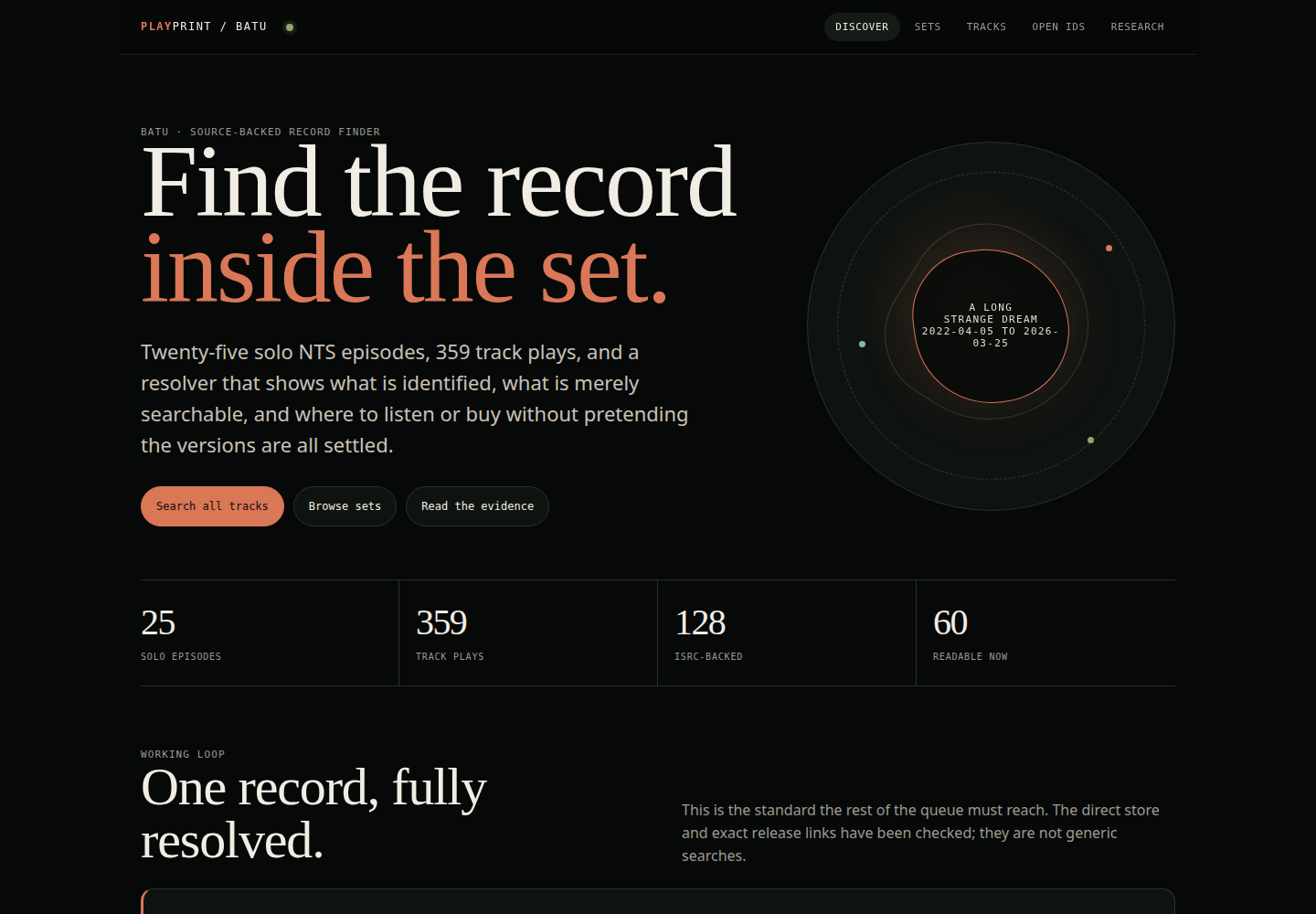
Batu’s solo-primary NTS episodes provide unusually strong track-level identifiers. That made the first profile a clean test of exact recording matches without mixing in B2B or guest selections.
25solo-primary episodes
359track plays
128ISRC-backed plays
19MusicBrainz links
Open evidence receipt
354 unique normalized artist-title pairs
85 NTS-supplied Deezer links
50-record destination pilot with exact-identifier gates
13 artifact tests and 22 desktop/mobile browser checks passed
Source mix
25 solo-primary NTS episodes
Stable identity
128 ISRC · 19 MusicBrainz
Destination pilot
50 strict records
Artifact gate
13 data · 22 browser checks
Boundary: Batu’s identifier coverage is unusually favorable. It proves the strict path, not average archive quality.
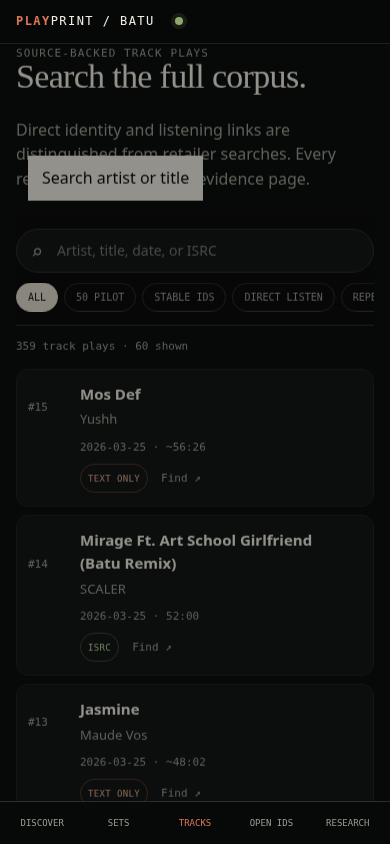
Discovery begins with what the source can prove.Batu track evidence at a true 390 × 844 viewport.
Profile / 02Working profileJuly 21, 2026
Four Tet
Coverage-rich portability smoke
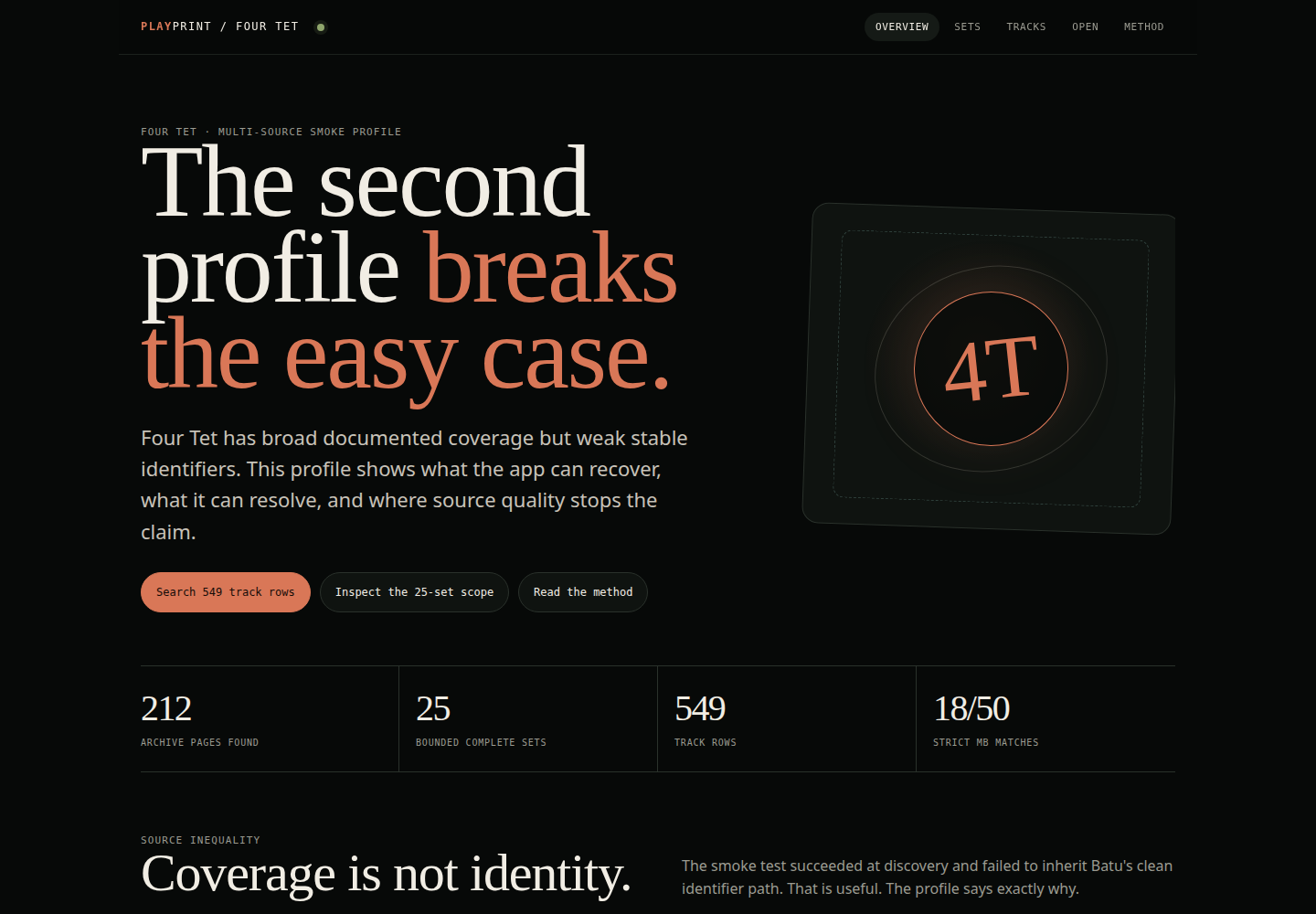
Four Tet produced more documented sets and far fewer stable recording identities. MixesDB supplied breadth; NTS supplied authority; the profile kept the gap between a typed track string and a verified recording visible.
25bounded complete sets
549track rows
18strict MusicBrainz matches
0NTS stable IDs
Open evidence receipt
212 MixesDB archive pages discovered
26 NTS episodes and 126 solo-primary NTS track rows
50 strict MusicBrainz candidates: 18 exact, 32 unresolved, zero API errors
29 unit/regression tests, 15 link checks, and 29 browser checks passed
Source mix
25 MixesDB build sets · 26 NTS episodes
NTS identity
0 stable recording IDs
Resolver pilot
18 exact · 32 unresolved
Artifact gate
29 tests · 29 browser checks
Boundary: Community tracklists provide coverage, not recording identity. The 25 sets are a bounded slice, not Four Tet’s complete history.
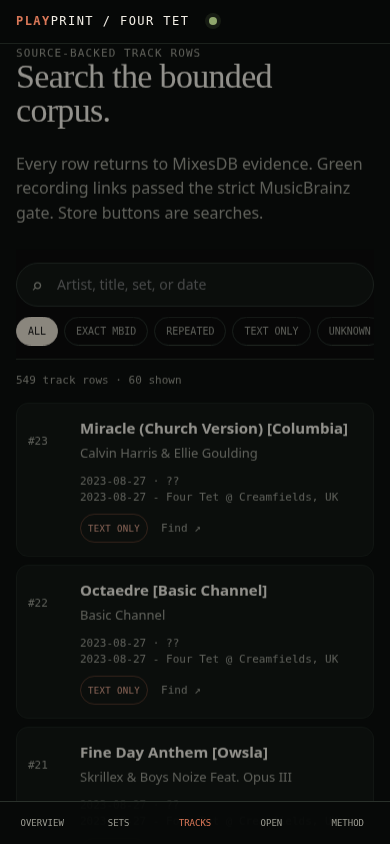
Four Tet source coverageFour Tet track evidence at a true 390 × 844 viewport.
Profile / 03Corpus receiptJuly 20, 2026
Seth Troxler
Volume-rich, attribution-heavy
Troxler has the largest set trail in the research corpus and the dirtiest text. Merged lines, inconsistent dashes, and a heavy B2B history make source attribution the hard problem before recording resolution even begins.
142strict identified sets
2,121identified track rows
1,886normalized tracks
191recurring tracks
Open evidence receipt
Corpus pattern
Repeat signals
Strict sets only
Exact artist-title pairs repeated across strict solo-live and radio sets. They are listening leads, not taste rankings.
Strict identified sets by three-year band
406–08
2709–11
4012–14
3015–17
1418–20
1721–23
1024–26
All 142 strict sets have a usable year.
Start with the repeats
01Good For MeDJ Dan & Jerome Robins · 2013–20185 sets
02SiliconDANNY DAZE · 20144 sets
03GrowlerPig&Dan · 20164 sets
Resolved trailhead
Floorplan / Never Grow OldOriginal album version · M-Plant MPM16The set string resolves to the original Paradise album version. The later Re-Plant remains a separate recording.
Three primary NTS episodes contain 50 track rows and no stable recording identifiers
74 of 248 title-matched MixesDB pages are collaborative or B2B
Floorplan’s “Never Grow Old” resolves to the original M-Plant MPM16 album version, not the later Re-Plant
Strict source mix
139 MixesDB · 3 NTS
Title-matched span
2006–2026
Shared-set risk
74 collaborative or B2B pages
NTS identity
50 rows · no stable recording IDs
Boundary: The 2,121 rows are normalized track strings from a research corpus, not 2,121 proven solo Troxler selections. Shared sets and merged lines still need set-level attribution before this becomes a working profile.
Profile / 04Corpus receiptJuly 20, 2026
Carl Craig
Deep-history alias test
Craig supplies the deepest archive and the cleanest released-record coverage in the original stress test. The problem moves from finding track strings to preserving versions and linking aliases without erasing the credited artist.
100strict identified sets
1,462identified track rows
1,113normalized tracks
176recurring tracks
Open evidence receipt
Corpus pattern
Repeat signals
Strict sets only
Exact artist-title pairs repeated across strict solo-live and radio sets. Alias links stay separate from the credited artist.
Strict identified sets by four-year band
594–97
798–01
802–05
1206–09
2310–13
2314–17
1118–21
1022–25
Ninety-nine strict sets are dated from 1994–2025; one is undated.
Start with the repeats
01ThrowPaperclip People · 1994–20179 sets
02Rushed69 · 1995–20248 sets
03Strings Of LifeRhythim Is Rhythim · 2005–20188 sets
Resolved trailhead
Paperclip People / ThrowOriginal · Planet E PLE653473The set string reaches Planet E’s official track page. Remake and Basic Reshape remain separate versions.
One primary NTS episode contains 24 track rows and no stable recording identifiers
Paperclip People’s “Throw” appears in nine sets; 69’s “Rushed” and Rhythim Is Rhythim’s “Strings of Life” appear in eight
The “Throw” resolver receipt reaches the original Planet E version, direct Bandcamp purchase, and release evidence
Strict source mix
99 MixesDB · 1 NTS
Title-matched span
1991–2026
Shared-set risk
43 collaborative or B2B pages
NTS identity
24 rows · no stable recording IDs
Boundary: Paperclip People, 69, Designer Music, and Innerzone Orchestra are connected to Craig, but they remain distinct credits. Forty-three collaborative or B2B pages are shared evidence, not solo selection claims.
The Sources Are Unequal
The research spikes tested Batu, Four Tet, Seth Troxler, and Carl Craig across radio archives, community databases, and music catalogs.
Authoritative structured lane
NTS Radio
Public endpoints preserve source-owned episode and track data. Batu is identifier-rich; Four Tet shows how sparse the same lane can be.
Supported discovery lanes
Mixcloud, BBC, independent radio
Official APIs or parseable public pages can extend coverage, but every adapter needs its own terms and attribution review.
Community leads
MixesDB and 1001Tracklists
Useful for discovery and corroboration. They do not become authoritative simply because the tracklist looks complete.
Excluded from automation
Resident Advisor
Technically extractable, but outside the production ingestion boundary under the current terms and robots policy.
Rinse remains useful as a recording node, but the sampled episode pages did not carry populated tracklists. Audio recognition may eventually fill some gaps. It stays outside the first product because it changes the cost, rights, and confidence model all at once.
A Link Is Not a Match
NTS supplied 84 unique Deezer catalog IDs in the Batu corpus. A current API audit found 59 readable records and 25 catalog records that were not readable from this region. Eighty-two API ISRCs matched the NTS ISRC. The 50-record pilot admits a track only when the destination is readable now and the ISRC matches exactly.
Set evidence→Exact recording→Release evidence→Checked destination
Ploy’s “Ramos” is the first complete cross-archive receipt: set evidence, exact recording, official listening page, Discogs release evidence, and direct Bandcamp purchase. Other retailer buttons remain labeled searches until the release and version are verified; three literal unknown-ID rows remain open.
What Broke During the Proof
Failure / 01
The research table widened the phone page
The table initially forced horizontal overflow across the whole document. It now scrolls inside its own container while the page remains at viewport width.
Failure / 02
Navigation landed below the wrong thing
Selecting a tool on mobile opened its content beneath the discovery hero. The interface now moves the chosen workspace into view before the person has to hunt for it.
The Batu and Four Tet profiles passed dedicated integrity, link, desktop, and mobile checks after their repairs. Seth and Carl remain corpus receipts until the same artifact gate runs for them. The distinction stays visible.
From Batu to Any DJ
Two profile runs prove that the pipeline can operate under unlike source conditions. Two additional corpus receipts expose the next hard cases before the interface claims to solve them. Seth forces collaborative attribution and dirty-line handling. Carl forces alias and version resolution across three decades. The general product should search on demand rather than copy the entire DJ internet into one brittle database. A cache hit can return existing evidence immediately. A cache miss can resolve identity, discover supported set sources, run the appropriate adapters, normalize tracks, and preserve every source URL and checked date.
01
Matched
One identity, source-backed sets, and a music list with visible evidence and checked destinations.
02
Ambiguous
Several artists share the name or alias. The person searching chooses the identity before extraction continues.
03
Sparse
Recordings or leads exist, but no reliable tracklist has been found yet. The gap stays visible.
IdentitySourcesTrack evidenceNormalizationRecording and releaseDestinationsCache
Build boundary / July 21, 2026
What Is Proven and What Is Not
Proven now
Evidence and provenance model
Batu and Four Tet profile-scoped extraction
Seth and Carl corpus-level stress tests
Exact-identifier and strict text-match gates
Searchable desktop and mobile prototype
Automated integrity and browser checks
Still open
Arbitrary DJ identity resolution
Production source adapters
Commercial ingestion permissions
Release-level purchase resolution at scale
Dedicated Seth and Carl artifact runs
Coverage testing beyond four DJs
The repository stays private while the source and data-rights boundary is reviewed. The next build turns the profile runner into a search API and tests more DJs who do not have Batu’s unusually strong NTS record.